
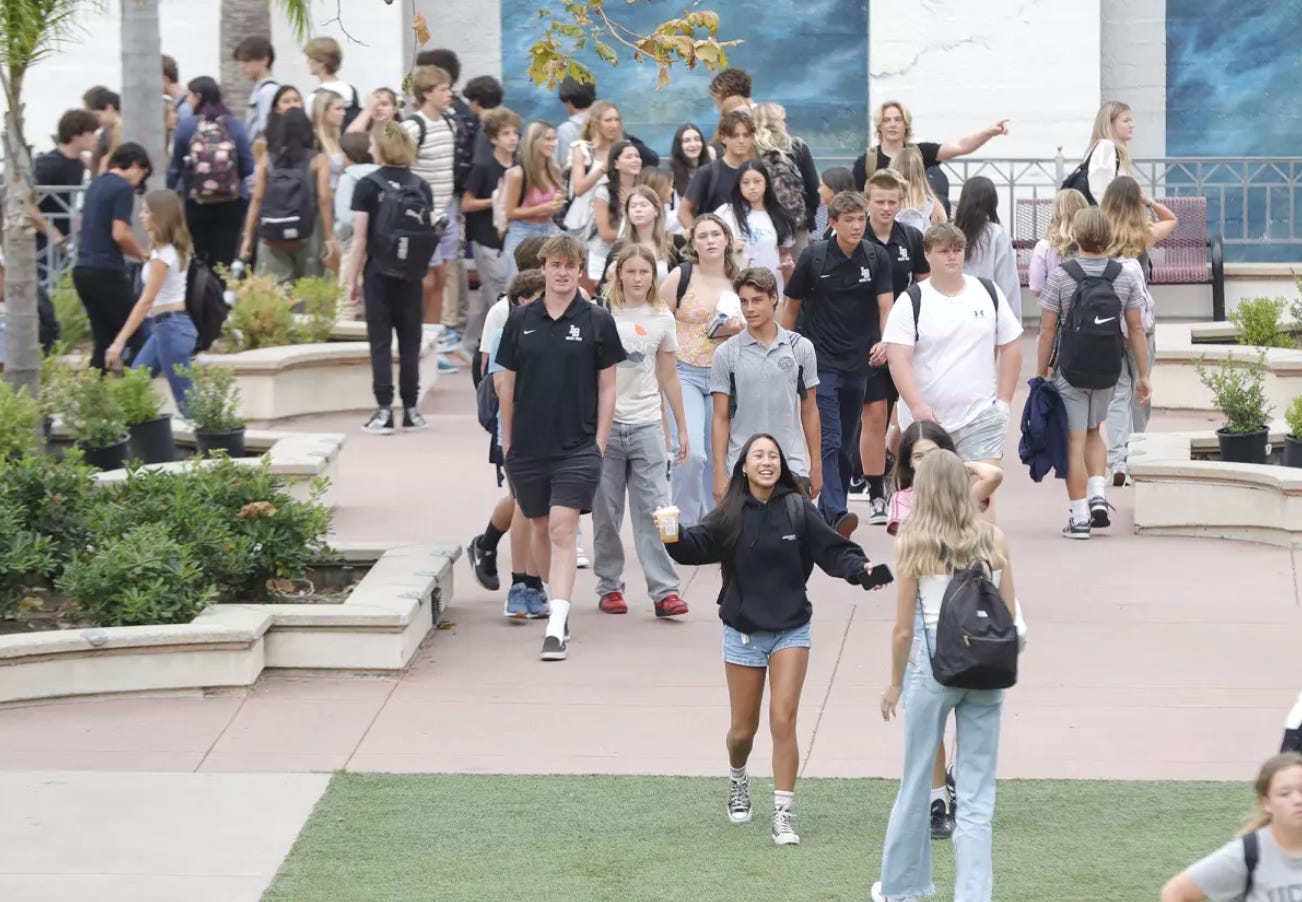
Erika Hennon Rule writes about Laguna Beach Unified, with a focus on board decisions and their implications for students, staff, and families. This piece originally ran on her marvelous Substack, A Public Record. She and I share a strong belief that our newsletters are neither for profit nor glory, but to inform (locally) in an age of misinformation. Erika will also be attending a pre-education rally this afternoon at 4 o’clock at 550 Blumont, with a walk toward Main Beach, followed by the LBUSD board meeting at 6:00 p.m. at the Thurston Middle School library.
In Laguna Beach, the cost-per-pupil number gets hauled out whenever someone wants to argue that LBUSD has become too expensive.
It is a neat little talking point. Look at the number, compare it to a district like Irvine, decide Laguna must be bloated, and move on. What gets skipped is how that number is built, how a basic aid district actually works, and what students are getting from that investment. It also skips an inconvenient fact: LBUSD says it ranked No. 1 among Orange County unified districts in statewide English language arts, math, and science scores.
That is why I have very little patience for people who use “cost per student” as if it proves the district is overspending. Most of the time, it proves something else: a lot of people are eager to judge a school system by a single number they do not really understand.
The number people keep weaponizing
LBUSD’s 2025-26 general fund budget shows about $87.5 million in expenditures. The district’s September 2025 Opening of Schools Report says LBUSD opened the year with 2,333 Preschool-Grade 12 students. Using these numbers, the district’s operating cost comes out to roughly $37.5k per student. The same budget shows about $33.8 million for certificated salaries, $12.9 million for classified salaries, and $20.7 million for employee benefits. Together, that amounts to about $67.4 million, or roughly 77% of general expenditures, for salaries and benefits.
That should not shock anyone who understands how schools work. Nationally, the National Center for Education Statistics reports that salaries and benefits account for about 79% of current public-school expenditures. School districts are labor-heavy institutions because educating children is labor-heavy work.
The number can get even bigger depending on what critics decide to fold into it. LBUSD’s 2025-26 budget also shows about $13.1 million in transfers out, including a routine transfer to capital reserves and a one-time $11 million transfer tied to the LBHS pool modernization project. If someone tries to blend those transfers into the operating picture, the all-in figure rises into the low $40k per student. That may be useful for a broader conversation about district outflows. Still, it is not the same as the annual classroom operating cost, and too many people treat those numbers as interchangeable.
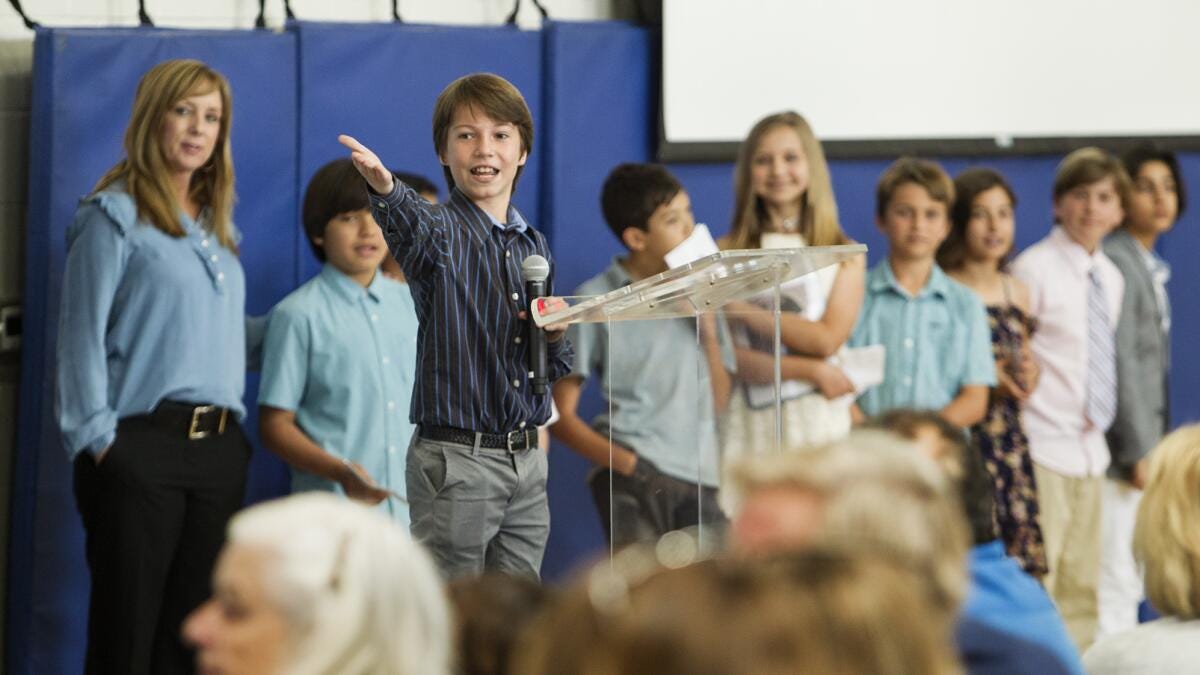
What students actually feel
LBUSD’s April 2026 staffing report lists average class sizes of 18.4 in K-2, 22.9 in grades 3-5, 23.7 in grades 6-8, and 19.6 in grades 9-12. Those numbers shape how much attention children get, how manageable classrooms feel, how much room teachers have to respond to individual needs, and how much stability families can expect.
That part tends to disappear when people start yelling about cost per pupil. The real question is what that investment is buying. In Laguna Beach, part of the answer is lower class sizes than many communities can offer and a school experience that feels more human and less crowded.
And there is serious research behind that. The Tennessee STAR experiment, one of the best-known randomized studies in education, found meaningful gains from reducing class size in the early grades from about 22 students to 15. Follow-up work found that those early classroom differences persisted into adulthood, including a higher likelihood of college attendance. One NBER paper estimated an internal rate of return of about 5.5% from reducing class size from 22 to 15 students, and Raj Chetty and coauthors found that students assigned to small classes were 1.8 percentage points more likely to attend college at age 20.
No one is claiming every class must be tiny to be good, but lower student-to-teacher ratios are not some luxury for rich parents. Class size is one of the few school inputs with unusually durable evidence behind it.
What people are really criticizing when they criticize staffing
When people complain about “high cost per student,” they are usually reacting to the cost of keeping experienced adults in schools.
They are reacting to teachers who have stayed long enough to move up the salary schedule. They are reacting to step increases, column movement, and rising health benefit costs. They are reacting to the reality that recruiting and retaining good employees in a wealthy coastal community is expensive, whether those employees live nearby or drive in every day.
Experience is not some sentimental talking point either. Research in Education Finance and Policy found large returns to teacher experience for middle school teachers, including higher student test scores and improvements in student behavior, with benefits extending well beyond the first few years of teaching. The Learning Policy Institute’s review of the literature reaches a similar conclusion: experience continues to matter more than the old “it stops after year three” line suggests.
That is part of what people are actually looking at when they decide LBUSD’s staffing costs offend them. They are looking at the price of stability. They are looking at the cost of keeping people who know the school, know the community, and know how to do the work well.
Basic aid changes the whole setup
LBUSD is a community-funded basic aid district. The budget shows that local property taxes exceed its LCFF entitlement, allowing the district to retain those property tax proceeds rather than relying on state aid as usual. For 2025-26, the budget projects about $78.9 million in LCFF and property-tax revenue. That financial structure is not the same as the structure in a district that depends much more directly on formula-driven state money.
So when people compare Laguna’s cost per student to a non-basic-aid district and pretend they have made some clean apples-to-apples case, they have actually skipped the most important part of the setup.
That does not mean spending should avoid scrutiny. It means the scrutiny should at least be intelligent.
California is not the benchmark people think it is
A lot of these conversations quietly assume that if Laguna Beach Unified spends more per student than the California average, then something must be wrong.
PPIC reports that California districts spent about $23k per pupil in 2023-24, but California ranked only 16th nationally on raw per-pupil spending and 31st once labor-cost differences were taken into account. So no, the statewide average is not some obvious proof point that districts above it must be reckless. Sometimes it just means the baseline is lower than people imagine.
If we want perspective, it makes more sense to look at other small, affluent, high-expectation districts around the country than to keep obsessing over California districts built on different assumptions. Scarsdale Public Schools in New York says it serves about 4,800 students, and its 2025-26 budget report puts spending at about $191.5 million. Falls Church City Public Schools in Virginia approved a 2025-26 operating budget of about $69.4 million, and official enrollment reporting there showed stable enrollment at 2,712 students. Those districts are not identical to Laguna Beach, and interstate accounting is never perfectly clean. Still, they show something the local critics prefer to ignore: communities with means and high expectations also spend real money on schools.
More money does change outcomes
There is also a deeper point here. The old “money does not matter” line has not held up especially well in the research.
One major study of school finance reforms found that a 10% increase in per-pupil spending each year for all years of public school led to more years of education completed, higher adult wages, and lower adult poverty rates. The same research found spending increases were associated with lower student-to-teacher ratios, longer school years, and higher teacher salaries. A later NBER review concluded that a policy increasing per-pupil spending for four years would improve test scores 92% of the time and educational attainment even more often.
That does not mean every extra dollar is automatically well spent, but it does mean the reflexive claim that higher spending is suspicious by definition is not well-supported.
The adults children count on
One thing that gets lost in these arguments is how much of a child’s daily life is shaped by the adults at school.
Teachers and staff are with our children for huge parts of the day. They are the ones helping them settle in, learn, regulate, recover, grow, and move through the ordinary moments that make up a school life. They see the hard days, the breakthrough days, the tired days, the proud days, and the days when a child needs a little more patience or a little more belief.
That matters to me as a parent. I want the people around my children every day to feel supported, respected, and glad to be there. I want them to stay. I want a district where strong educators and staff are treated like the foundation of the student experience, because that is exactly what they are.
When people reduce school spending to a complaint about cost per pupil, they lose all of that. Critics turn the adults who hold schools together into a number. I do not see them that way, and I do not want this district to start treating them that way either.
What I want from LBUSD
I am not interested in Laguna Beach winning some symbolic prize for looking cheaper on paper. I am interested in what students experience.
I want strong teachers in classrooms. I want them to stay. I want lower ratios where they matter most. I want stable staffing, meaningful support, good electives, functioning schools, and adults who are supported enough to bring their best to children every day.
LBUSD is lush by public-school standards. Good. I want that used. I want every available dollar aimed at making the student experience richer, steadier, smarter, and harder to replicate.
Children do not go home talking about cost per pupil. They go home carrying what the adults around them did with their day.
If a large share of LBUSD’s budget goes to teachers, staff, and operations that make school feel stable, rigorous, and well-supported, then that money is doing exactly what I want it to do.
As a former Governing Board member of the LBUSD, I appreciate this piece. One of the facts that is often lost is LBUUSD is one of the few basic aid districts in California. It benefits when property tax revenue is high and has to plan for dips when assessments are challenged and revenue decreases. It also benefits from one of the most generous educational non-Profit, SchoolPower--a 501(c) 3 which raises goo gobs of money for teachers to supplement the budget. For a school district with only one H.S. of fewer than 1000 students, it has enriched IB and more AP courses than any HS its size.
Laguna School District fraudsters Viloria, Dixon and Ureno alliance is now trying to scam South Whittier School District. The Superintendent search team looks like a group of scammers.
https://www.swesdsearch.com/#apply