
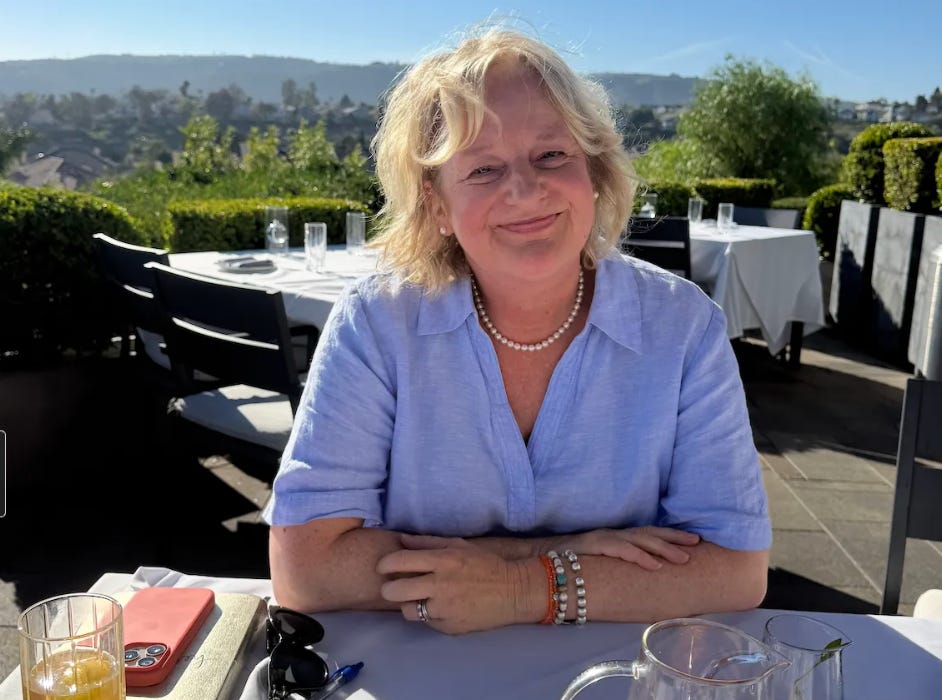
A confession: Before sitting down with Katrina Foley last week at Bottega Angelina in Laguna Niguel, I was very much prepared to dislike her.
The District 5 Orange County Board of Supervisors rep had been described to me—by various people of various stripes—as blunt, raw, (occasionally) dismissive, (occasionally) lacking tact and edgy. There are warm and cuddly local political figures who tell you exactly what they presume you want to hear. They pretend to remember your name; laugh at your mediocre jokes; make empty promises they know will never be revisited.
And there is Katrina Foley.
Someone I know and trust told me that, at her core, Katrina Foley is “a wonk.”
“How do you mean?” I asked.
“She loves her job,” the friend said. “Loves it. Loves meetings. Loves policy. Loves putting pieces together. She’s probably not gonna hug you, and she can definitely sound a little harsh, but she’s gonna work her ass off for you.”
And, ultimately, that’s the Katrina Foley I met. In the midst of a tight re-election campaign against Republican Diane Dixon (a former Foley friend, turned rival), Foley was candid, open and real in her takes on the campaign, on the struggles of political life, of Dana Point Harbor headaches and the threat of pesticides and her (bizarre, bewildering) love of meetings.
One can visit her website here, and donate to her campaign here.
Peeps, I bring you Katrina Foley …

JEFF PEARLMAN: “All right. Serious first question. I have no idea why anybody would want your job. I understand public service and greater good and all that, but it just seems miserable running, fighting. Then you get elected and people yell at you. Why even do this stuff?”
KATRINA FOLEY: “Yeah. So, I will say in general, I actually love this job. I didn’t really know what a county supervisor did. I had a general understanding, but our county supervisors were MIA in my area. And so, I thought it was more like city council, mayor, part-time kind of thing. But once I got here, I realized that you have so much influence on so many things. Social service safety net, homelessness prevention, development projects and the airport, all these things that I find to be fun to get involved in and solve problems for.
“So, in general, I love the job. It gives me a lot of reward to help people every single day. I know that sounds corny, but I actually respond to my emails. I like to help people. But I would say it’s very much harder to get good quality candidates. People who care about policy, people who care about responding to community needs and aren’t just doing it for some political reason.
“It’s hard to get those people because usually there’s all these challenges. They’re either professionals that are working and they don’t have the time to commit to something like city council or school board, or maybe they have the time, but they don’t have the thick skin, I’ll call it, to put themselves through the ringer, to have their personal attacks on them, their family at risk, people coming to their house. This is a different time now that we’re in.”
JEFF PEARLMAN: “You literally had people come to your house?”
KATRINA FOLEY: “Oh yeah.”
JEFF PEARLMAN: “Come to your house?”
KATRINA FOLEY: “Yes.”
JEFF PEARLMAN: “Knock on your door?”
KATRINA FOLEY: “They came to my house at least three times. It could have been four, I can’t remember. And I had to get the dignitary detail to come over because they had flags and their megaphones and they were yelling things at me. The first time it happened, I was mayor of Costa Mesa. And it was during COVID. And my husband and I and my son, we’re in our backyard and we’re in the pool. I’m in a bikini swimming around with my family. And then I hear all this commotion and I’m like, ‘What is that?’ So, I go over to sneak a peek over the fence and I realize, “Oh no, they’re at our house.’ So, I run to get a towel.
“My backyard is the soccer fields. So, you could see into my backyard from the public soccer field. And then people start coming around the back. I’m like, ‘Okay, I don’t want any pictures of me into my bathing suit.’ And of course, my husband would say, ‘Well, that’d get you votes.’ I’m like, ‘I don’t think so.' Maybe 20 years ago.’ So that was our first experience with that kind of a chaotic situation. And then it happened several other times when I became the county supervisor. And so, yeah, my house is now a place where we have a drive-by every once in a while, I mean, in terms of the police presence.”
JEFF PEARLMAN: “Do you feel like we live in a time where you can’t just go out and talk to these people and be like, ‘Hey, what do you guys wanna discuss ...’ Is it far past that?”
KATRINA FOLEY: “Three of the people that were at my house in that time period either pled guilty or were charged during the insurrection. So, no, I’m not going out and talking.”
JEFF PEARLMAN: “No, I think that’s wise.”
KATRINA FOLEY: “You don’t really know the difference between ... sometimes when I was on the city council, a lot of rhetoric. There was this one guy, he was a self-described white nationalist and he’d always target me at the podium, but he was like one. There wasn’t a movement of him in our city. And the people that would come to the podium would have legitimate community issues that they wanted to address their council about and get redressed. Whereas now I just feel that sometimes people come and they tell us we’re going to go to hell. I mean, they say things that you can’t tell if it’s just rhetoric or they’re actually going to try to hurt you.
“I always err on the side of, ‘Okay, they’re using their public speech.’ I’m a huge advocate for the First Amendment, so I’m not going to cut anyone off from speaking. But at the same time, sometimes the words are insightful of violence.”
JEFF PEARLMAN: “Do you feel like in this regard, there’s a pre and post-COVID element to it?”
KATRINA FOLEY: “For sure. Yeah.”
JEFF PEARLMAN: “Something broke.”
KATRINA FOLEY: “Yeah. There was a change. And it’s gotten a little better over the last year, I would say. It’s not as dramatic as it was for the first couple of years I was on the board. So, there’s that, but that’s only part of the job. The board meetings occur twice a month, sometimes once a month, depending on how the days fall. And so, that’s that.
“But overall, our office is out working in the community, having positive experiences with the chambers, with new small businesses, with the community groups, the sand advocates. I’ve never learned so much about sand in my whole life. I never would think that this would be something I would be an expert on. Working with our Latino families in some of the areas of the south county area that had never had anybody even talk to them. They didn’t even know they had a county supervisor or what that was really.
“So, I like working with our healthcare safety net groups and the environmentalists. There isn’t a small business that I don’t like supporting. So, it’s really enjoyable, I’ll say, to do the work and to be out in the community. And people always say to me, ‘Oh, you have so much energy. How are you everywhere? And you’re so energetic. How do you not get tired?’ And it’s a strange phenomenon because I don’t get tired. I could go into a big, huge community meeting tired and leave super amped up and can’t go to sleep because I get fuel from the people.”
JEFF PEARLMAN: “What time do you wake up in the morning usually?”
KATRINA FOLEY: “I start texting people early. I’m usually up no later than 6 o’clock.”
JEFF PEARLMAN: “What time do you go to bed?”
KATRINA FOLEY: “I probably go to bed around 11.”
JEFF PEARLMAN: “You are not getting enough sleep there.”
KATRINA FOLEY: “I know, I know. I know, but I try. Even when I go to bed early, my clock doesn’t let me sleep more than six or seven hours. I just can’t do it.”
JEFF PEARLMAN: “Wait, so here’s something about you that I think is really interesting. You may disagree. My least favorite part of having started this website is any meeting. I hate meetings. I don’t like meetings as a sports journalist. I’ve never enjoyed meetings.”
KATRINA FOLEY: “You would not like this job.”
JEFF PEARLMAN: “Facts.”
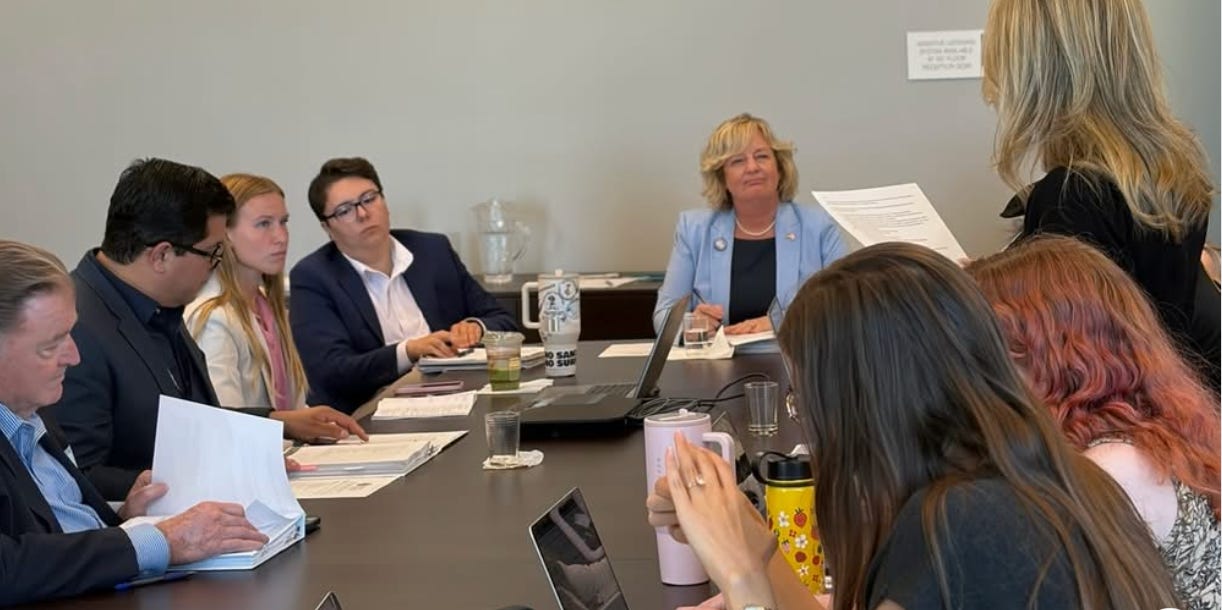
KATRINA FOLEY: “I have meetings all day long every day.”
JEFF PEARLMAN: “Wait, all I see when I go to your Facebook page, ‘So excited to be at the blank’ and ‘Happy to be at the blank’ and ‘Was at the blank’ and ‘At the blank.’ Here she is at a table. Here she is speaking. I hate meetings with every part of my body. And you seem like...”
KATRINA FOLEY: “I like meetings.”
JEFF PEARLMAN: “How does one like meetings?”
KATRINA FOLEY: “Okay. So, Monday, you would have hated my day.”
JEFF PEARLMAN: “Okay. Tell me your full day Monday.”
KATRINA FOLEY: “My full day Monday. I started my day at 9 am in a meeting, and I went from 9 to 4:30 in back-to-back meetings, back to back to back. I didn’t stop meeting with people. Mostly staff coming and giving me briefings on initiatives and updates and preparation for the board meetings and all that. Mondays are when I do all those briefing meetings. They didn’t even give me time to eat lunch or go to the bathroom. I had an OCTA Zoom meeting and it finished at 3:40. And I’m like, ‘I’m reclaiming my time. I’m going to stop the meeting now since we’re done. We don’t need to chit-chat because I got 20 minutes to eat lunch.’”
JEFF PEARLMAN: “That’s funny.”
KATRINA FOLEY: “So, yeah. I mean, I like meetings.”
JEFF PEARLMAN: “You really, truly, genuinely like meetings?”
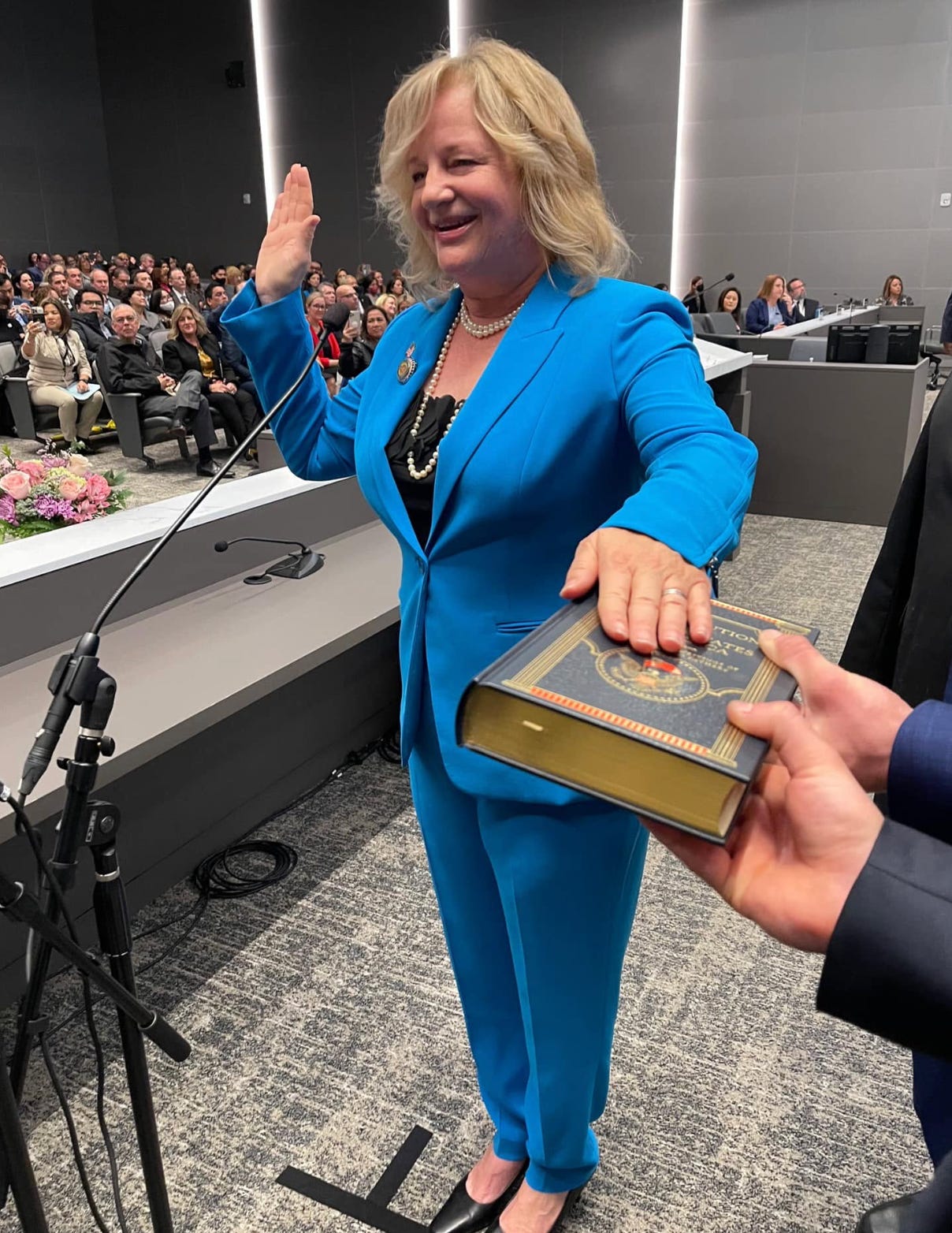
KATRINA FOLEY: “I do. Some of the meetings I like … is sometimes you can’t get the work done unless you have a meeting. People think meetings waste time, but what I try to do, I try to be efficient with the meetings, especially when we’re trying to solve a problem. So, I’ll give you an example. Dana Point Harbor, when I first got elected in December of 2022, before I got sworn in to the fifth district, I went and had a briefing with the Harbor Partners, SDG&E, the county real estate, all these different groups.
“So, I had what Alyssa [Napuri, Foley’s deputy chief of staff] likes to refer to as a full Foley meeting. And that is where I pull everyone together to try to figure out what’s the clog? Who’s creating the clog or the cog in the wheel? And so, in this case, we had no utility permits for the parking structure for the Data Point Harbor. And the importance of that is that they can’t do anything until they get the utility permits. And at that point, they’re almost four years, five years into the contract. So, everyone’s pointing fingers. The developers are saying that it’s SDG&E. SDG&E is saying that it’s their consultant, the county. Everyone’s pointing fingers.
“So, I just went about asking that question. I’m one of two women in the room. It’s all men. And I just asked every single one direct questions to try to find out what was the problem. And then I said, ‘Okay, send me all the emails, SDG&E, that you have related to this certification.’ And it turned out we figured out the problem. The problem was the guy wasn’t certified to get the permits, so he couldn’t sign what was called a welcome packet. It was like a simple thing that was the problem causing us not to get the permits. But nobody knew because everybody’s delegating and they’re just assuming everyone’s doing what they’re supposed to be doing.”
JEFF PEARLMAN: “Wait, super nerdy follow-up. How did you figure out what the problem was?”
KATRINA FOLEY: “I listened to all what they were saying and I asked for the emails because I felt like, okay, I’m going to read the thread of emails to figure out what is supposed to happen next. And I read all the emails and there was an email that was a welcome package. It’s an SDG&E procedural requirement. You have to sign this package, but the only way you could sign the package is if you’re certified as a utility consultant. The guy wasn’t certified. It was that simple. And so, we discovered that and then, wow, solution found. And we ended up getting somebody else to handle it and then moving forward. It was like, boom, it all flowed after that. But I don’t know, sometimes people don’t ask questions.”
JEFF PEARLMAN: “So, I write books for a living, and I wrote a book about the rapper Tupac. And finding little things like what kind of cigarettes he smoked or the name of an aunt or something like that just gives me a jolt. You seem super nerdy in that way too …”
KATRINA FOLEY: “Well, yes. It’s also because I was a litigator, and I’m still a litigator, I just don’t go to trial anymore, but for nearly 30 years. So, as a litigator, your job is to find the smoking gun and the needle in the haystack to prove your case. So, I just approach all of these county problems that are what seem to be gigantic problems that people can’t solve for all these decades like I’m a litigator trying to prove my case. So, I mean, it helps.”
JEFF PEARLMAN: “Did you get a high off of it? You find the reason the parking can’t be …”
KATRINA FOLEY: “Oh yeah, yeah. Of course. And that’s why I love this job. Every day I get to solve some problem. And I didn’t really realize about myself how much I like solving problems until I got this job. I mean, I knew it, but not really.”
“But I also get really frustrated if I can’t solve the problem. So, that’s the downside. I’m not one of those politicians that can just say, ‘Well, that’s somebody else’s problem. I did my part.’ I feel like obligated to fix it.”
JEFF PEARLMAN: “What is an example from your career of something you weren’t able to fix that you wanted to fix? Or something you wanted to solve and couldn’t quite figure it out?”
KATRINA FOLEY: “Well, I’m experiencing it right now, Dana Point Harbor. I thought we had it all solved, but all the politics is getting in the way of the progress.”
JEFF PEARLMAN: “Wait, obviously I’ve got to ask about this, but I’m actually fascinated by Dana Point Harbor a million different ways. So I can’t say I love Newport as a place to go. Meaning, I used to write my books at the Harbor House. And I like sitting in a corner booth at the Harbor House. It smells a little funky and the food is grimy and gritty and … I dig that. Is there a concern that Dana Point at the end of the day is going to wind up being Newport II?”
KATRINA FOLEY: “Well, first of all, I don’t think it’s going to be Newport. Believe it or not, the perception about the Newport Harbor is not actually what Newport Harbor is. There’s a lot of mom and pops. There’s a lot of really long-time businesses in Newport Harbor. There’s a lot of old money in Newport Harbor. It’s not all shiny and new like everyone’s thinking. So, I do think it’s going to be very different. My dad was a deep-sea fisherman in Santa Barbara, so he’s had every dirty job you could imagine. And there’s a relevance to this story. I was in high school when he was a deep-sea fisherman in Santa Barbara. My senior year, I think. It turns out Joe Ueberroth was revitalizing the harbor in Santa Barbara.
“And as part of that revitalization, the old-school fishermen who fished out of the harbor, who hung out at the ... I can’t think of the name of it right now, but the little cafe there, all the places you’re talking about. We had those at Santa Barbara Harbor also. And people got really upset because they were going to get rid of all these places and the new places were going to take over and it wasn’t going to have the same character that it had. But the new harbor got built and people still go to the little cafe. It just has a different facade now. And the fishermen found a new place to hang and everybody found their corner, if you will. I suspect that will happen here. And to me, it’s not going to be like Newport. It’s unique in and of itself. It doesn’t feel like Newport to me.
“I think the whole thing, ‘Don’t Newport my Dana Point,’ is really because the developers are from Newport. And so, that’s where I think that comes from. But it doesn’t matter who was in charge of tearing down the buildings. People would be upset. But, look, I had my office in one of the buildings. They were old, leaking, very inefficient, the heat and air not working. The county just left the harbor to deteriorate all these years.
“And if there’s one thing that I have tried to bring to the job is that we have to maintain our infrastructure. We can’t just let things deteriorate like what was happening in this harbor for decades. Not even just a couple years, decades. So, I don’t think it’s going to be like Newport. I think it’ll be its own. It’ll create its own little community. People will still get out there and walk. The Jazzercise ladies that have been going there for 35 years, they’re going to still be there. And we’ll have our county area where we have all the free amenities.”
JEFF PEARLMAN: “What are the biggest pains in the ass for you in regard to Dana Point and this getting completed?”
KATRINA FOLEY: “I feel like I’m the scapegoat for the failure to find financing.”
JEFF PEARLMAN: “Ah.”
KATRINA FOLEY: “I think the hotel developer can’t find the financing. She’s trying to blame me.”
JEFF PEARLMAN: “How do you deal with that as a political figure? Because on the one hand you’re running for re-election. On the other hand, job’s a job …”
KATRINA FOLEY: “Yeah. So, I’m trying to get the project, the lease agreements approved so that there isn’t an excuse that you can’t find financing. If after the leases are bifurcated, which they keep saying is the reason they can’t get the financing, then what’s your excuse now? I mean, you signed a contract in 2018 that included commercial core marina hotels all under one lease. Well, you must have known in 2018 that you weren’t going to be able to get the financing because that’s what they say, they couldn’t get the financing because the hotels have to be separated out.”
JEFF PEARLMAN: “Is it tough to be in your position where any business person can blame the local political figure?”
KATRINA FOLEY: “Oh, yeah.”
JEFF PEARLMAN: “But the local political figure has to be really careful about blaming a business person.”
KATRINA FOLEY: “For sure. But what I will say in my 25 years of public service, starting as a planning commissioner, I have worked with incredible property owners. Henry Segerstrom, who had great vision, who did everything in a professional way. Working with staff, working with you, addressing any concerns of the council as a whole, of the planning commissioners, trying to find yes always. Compromising where they could to get to yes so everyone could have a win and we could all celebrate. William Lyon, Irvine Company, The Ranch, Tony Moiso. No one does what’s happening here, where you’re taking this all like a street fight in the media. I’ve never experienced this before.”
JEFF PEARLMAN: “Does it make your head explode?”
KATRINA FOLEY: “Well, it’s kind of disappointing because Alyssa and I put our heart and soul in trying to get the approvals for the entitlements. We used a lot of political capital, both with the Coastal Commission, with the labor unions, with community groups. And we really did it because we believed in the outcome is going to benefit, hundreds of jobs going to be created. Lots of revenue coming in for the county and to help the county side of the harbor stay functional.
“When I first got the job to represent District 5, the prior supervisor had in the works, which I had to stop, to give the Dana Point Harbor Partners a contract to take over the county side as well. And the residents would’ve been completely opposed to that, which they’re even the feedback we get just we have a notice because we have this community meeting tonight. Everyone’s freaking out thinking it’s going to be the same thing. Commercializing of the ... to have to keep saying over and over and over again, ‘That’s not what we’re doing. We’re just trying to upgrade. It’s old. It needs to be upgraded.’”
JEFF PEARLMAN: “Wait, so you have a meeting tonight?”
KATRINA FOLEY: “Yeah. A meeting. Another meeting.”
JEFF PEARLMAN: “I was going to say, are you more revved up for it? Or are you like, ‘I would love to go home and watch realty TV?’”
KATRINA FOLEY: “Well, first of all, I don’t watch reality, just TV. I’m more into ‘Gilded Age’ and ‘Bridgerton.’”
JEFF PEARLMAN: “Fair.”
KATRINA FOLEY: “But no, I’m a workaholic. I love working. I would be working on something even if I’m not going to a meeting. I’m not good at relaxing.”
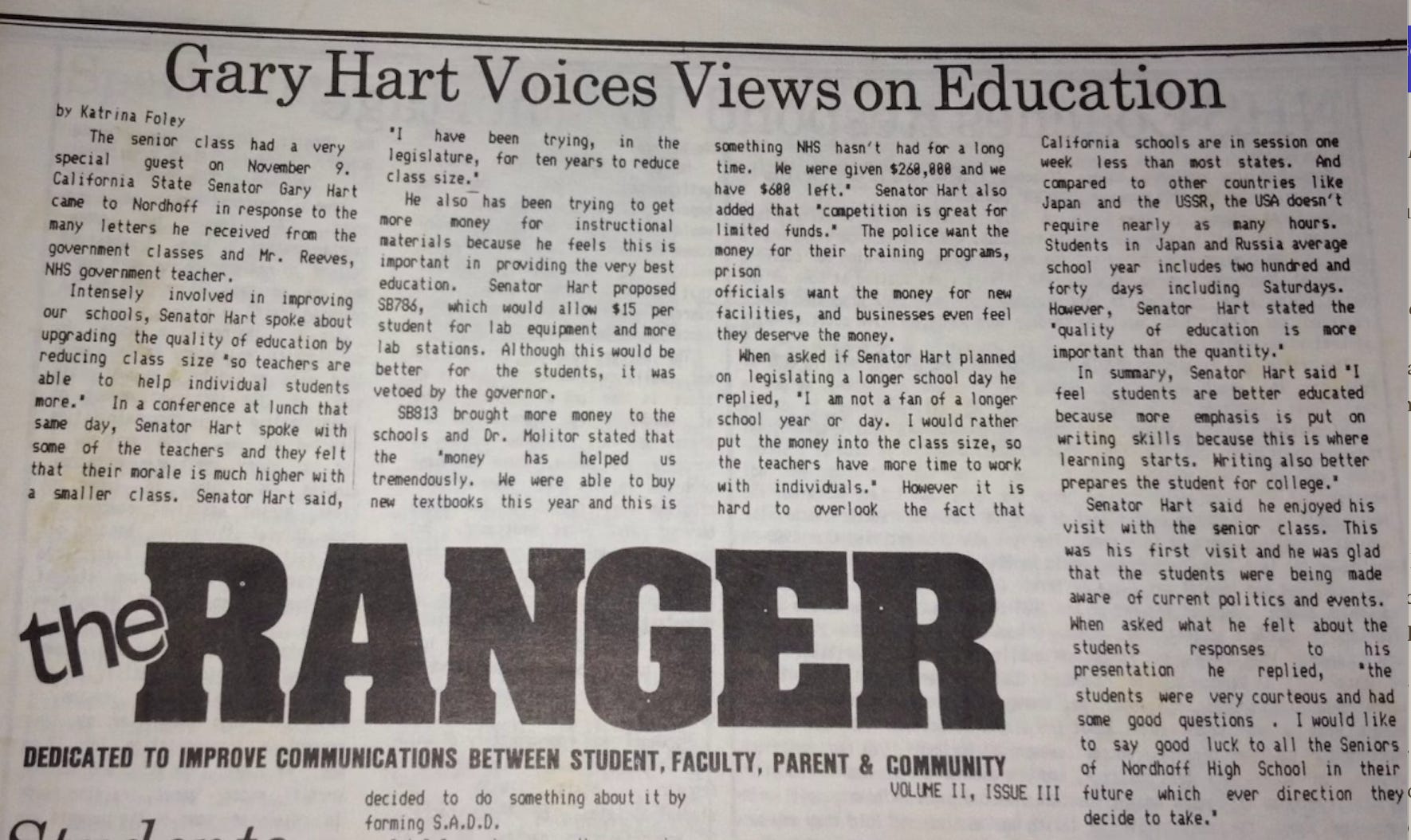
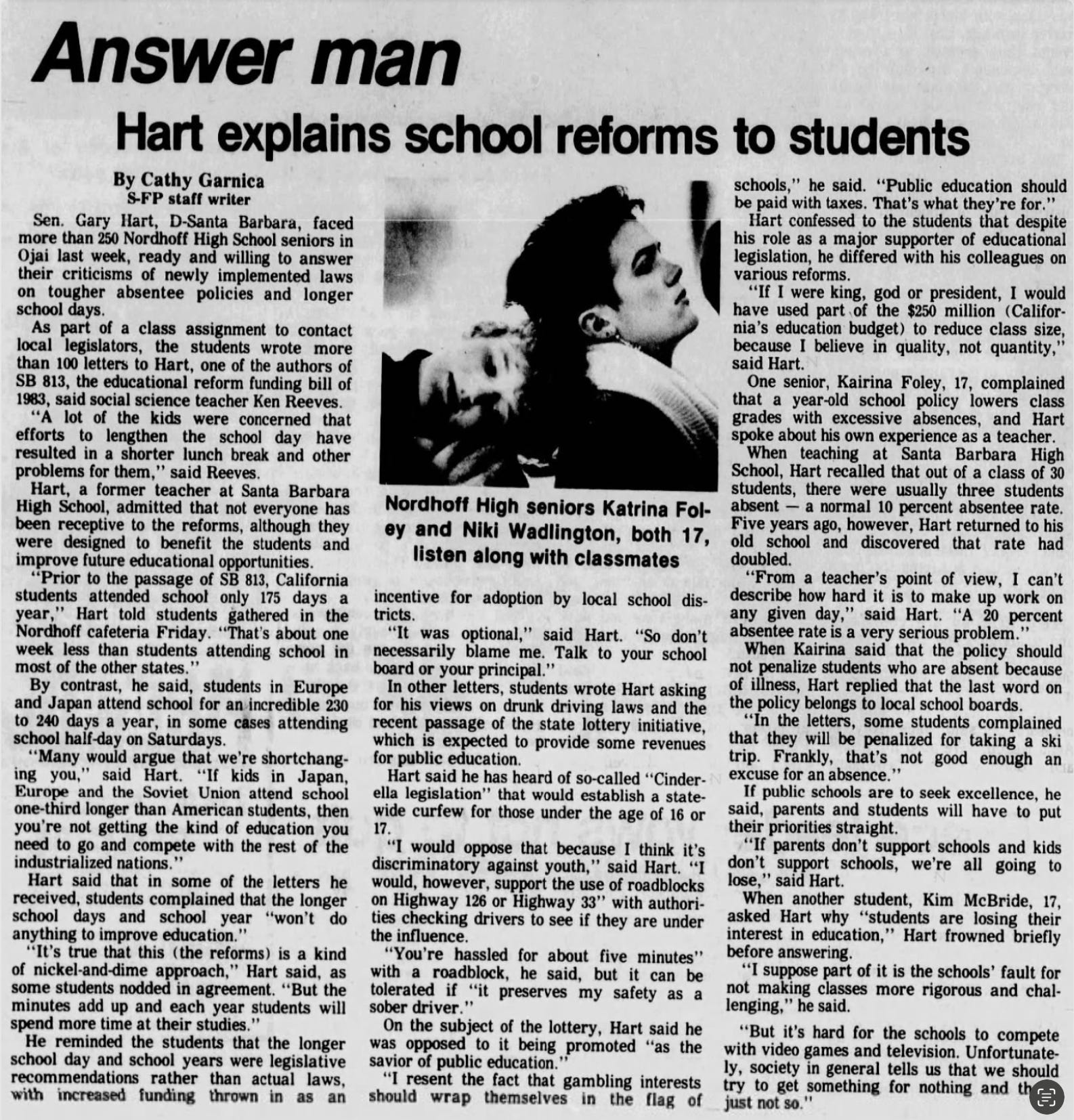
JEFF PEARLMAN: “Nordhoff High School, 1984, found the article on you …”
KATRINA FOLEY: “Ha. I know.”
JEFF PEARLMAN: “It was actually very affirming. You were this way in 1984. So, I’m actually interested. Growing up, when was your first idea or germination of, ‘I might want to go into some kind of...’”
KATRINA FOLEY: “Never.”
JEFF PEARLMAN: “Never?”
KATRINA FOLEY: “Didn’t even cross my mind. I didn’t know what politics was. Even in 1984 when Gary Hart came to our school …”
JEFF PEARLMAN: “Did you even know who Gary Hart? I know it wasn’t the Gary Hart who ran for president, but did you know who Gary Hart was?”
KATRINA FOLEY: “I knew who he was because he was coming to our school and I was assigned to interview him.”
JEFF PEARLMAN: “You wrote for the high school newspaper?”
KATRINA FOLEY: “Yes, yes. It’s so funny, I had forgotten my question until I reread that today. So, the reason I was asking about the absences was twofold. I lived on my own that year ...”
JEFF PEARLMAN: “In high school?”
KATRINA FOLEY: “I was not living at home. My mom and my siblings had moved to Texas and I did not want to move to Texas. And so, my mom arranged for me to have a room that she rented in someone’s house, and I lived on my own.”
JEFF PEARLMAN: “Wait, what town was this?”
KATRINA FOLEY: “Ojai. And then my senior year, I moved from there into my friend’s. I live with my friend’s family. And I worked at McDonald’s. Ojai does not allow any franchises. So, McDonald’s opened on the outskirts of Ojai.”
JEFF PEARLMAN: “What year are we talking?”
KATRINA FOLEY: “It was 1984 or ‘85. I graduated ‘85. So, I got a job at McDonald’s. I was on the track team that year also. So, I was working. Sometimes I would miss an elective because I had to go to work. And then I hurt myself in a track meet.”
JEFF PEARLMAN: “What was your event in track?
KATRINA FOLEY: “One time I did the 100-yard sprint and I never did it again. I ran cross country. I was not a short distance runner, but the coach was like, ‘You can do it.’ Coach was wrong.”
“I could speak in front of 500 people, but running 100 yards terrified me. So, I never did it again. But I pulled something, whatever. I don’t even remember. So, I was out of school for a couple days. But they had this weird rule, which I still to this day would oppose. If you’re getting an A or a B or whatever the grade is on all your tests and all your papers, why would you get your grade lowered for absences? That is stupid. Because kids have lives.”
JEFF PEARLMAN: “Sure.”
KATRINA FOLEY: “But anyway.”
JEFF PEARLMAN: “Wait, no, not anyway. So, Gary Hart comes to school …”
KATRINA FOLEY: “Yeah.”
JEFF PEARLMAN: “And you kind of fire away.”
KATRINA FOLEY: “Yeah. But it’s funny because that article, and if you read it in context of who I am now, you might think I’m this way always. But no, at that time in my life, I helped with the junior varsity cheer squad. And I was all about my girlfriends and my boyfriend. And I was not at all interested in politics. I didn’t even know what politics was.
“And I did not get interested in politics until I got to UCLA. I mean, my mom was apolitical. We didn’t talk about politics. I had no idea what politics was. I got to UCLA and then my whole world changed. It was the Year of the Woman, Senator Boxer, Senator Feinstein around the ballots. I interviewed Senator Boxer because I was the editor for the news magazine, for the women’s magazine on campus.”
JEFF PEARLMAN: “Do you remember interviewing her?”
KATRINA FOLEY: “Oh, yeah. I even have the cassette tape still.”
JEFF PEARLMAN: “Were you terrified or were you confident?”
KATRINA FOLEY: “I mean, I think I was probably nervous. Look, I was a ballerina and I did dance recitals as a girl. That was my escape from my dysfunctional family. So, I think I always figured out a way to project confidence even if I’m nervous. So, I’ve been doing that for my whole life. So, people don’t always know if I’m nervous. But in that case, I don’t remember feeling nervous, but maybe I was. Who knows? It was a long time ago.”
JEFF PEARLMAN: “Wait, I have to rewind here. You’re a senior in high school. Your parents are divorced?”
KATRINA FOLEY: “Yeah. So, my parents were divorced when I was two. And then my dad lived in Santa Barbara. I lived with my mom lots of different places. I have two siblings. And my brother’s an army veteran. But my stepdad is who we lived with in Ojai. And he is what I refer to as my evil stepfather.”
JEFF PEARLMAN: “Does he know that you refer to him as your evil stepfather?”
KATRINA FOLEY: “Well, he’s dead. I don’t care. He knows how much we don’t like him. So, he’s actually the reason that in my yearbook it says I want to be a lawyer. And that is because he was a bad man, raging alcoholic. He would take our family on these terrible excursions. It was horrific. I was like the adult in the room at 12, but he always targeted me. I was the target. And so, my mom was always trying to protect me against him. That’s why I was always in activity, so I didn’t have to be at home.”
JEFF PEARLMAN: “Did your mom work or she stay at home?”
KATRINA FOLEY: “No, my mom worked. Oh, she had to work. I mean, she did all kinds of different jobs. Real estate and sales.”
JEFF PEARLMAN: “Is she still alive?”
KATRINA FOLEY: “Yes. We built her a house in the back.”
JEFF PEARLMAN: “Oh, cool.”
KATRINA FOLEY: “Yeah. But this guy, he was just a bad person. And the ultimate definition of how bad he was, was that when my mom took my sister, who was my half-sister, and my brother, and they moved to Texas, he tried to get custody of my little sister because he wanted the disability check. And so, he took our family through this horrific trial. And my mom had a friend who was a lawyer. He was a corporate lawyer. In retrospect, I learned all this as an adult. He didn’t know family law. My mom just got put through the ringer. He got custody of my sister, which he never should have. And he laid out this whole thing.
“My sister actually thought that her dad wanted her. He didn’t want her. He just wanted the money. And it was very painful to my sister. It was painful to our whole family. And I said that day, I’m going to be a lawyer because I don’t want any women to go through this again.”
JEFF PEARLMAN: “You remember this?”
KATRINA FOLEY: “Oh, yeah. Oh, I do. Because he put me on the stand and it was terrible. So, I was probably 13 at that time. And it inspired me to become a lawyer. Now, I ultimately didn’t do family law, but that’s what got me committed to representing people who don’t have a voice to represent themselves. So, I can thank him for that, even though I despised the man.”
JEFF PEARLMAN: “Wait, I’m not letting you off this easy. You’re a senior in high school and your mom and your evil stepfather and your siblings moved to Texas.”
KATRINA FOLEY: “My stepfather didn’t move. My mom left because she finally realized she had to get out of there. And I was on my own my freshman year.”
JEFF PEARLMAN: “Freshman year of?”
KATRINA FOLEY: “High school. Fourteen. So, I’ve been on my own. I mean, I’m not living by myself. We rented a room for me. I’ve been pretty much independent since I was 14. And so, I’ve been working since I was 12 because my mom was really poor and we didn’t have any money. So, if I wanted a new Chemin de Fer jeans, I had to work for it.”
JEFF PEARLMAN: “What were the different jobs besides McDonald’s you’ve had in your early working days?”
KATRINA FOLEY: “So, I cleaned a lady’s mobile home and it was through the Youth Employment Service Organization. Her house was spotless. She just wanted to help young people. I babysat, obviously. Everybody babysits at my age. And then I sanded gourds for a while.”
JEFF PEARLMAN: “How does one enter the sanded gourd industry?”
KATRINA FOLEY: “The Youth Employment Service. They just had these random jobs. I was a Girl Friday, I was a cocktail waitress, a bartender.”
JEFF PEARLMAN: “What a Girl Friday? I’m sorry …”
KATRINA FOLEY: “I did errands for this restaurant owner, this French restaurant. I would run around, go to the grocery store, pick up things for him. They don’t call it that anymore. But yeah, I cleaned motel rooms. Yeah, I had a lot of jobs. Legal secretary. That was my year after college, legal secretary. And then after that, it’s all been lawyer jobs.”
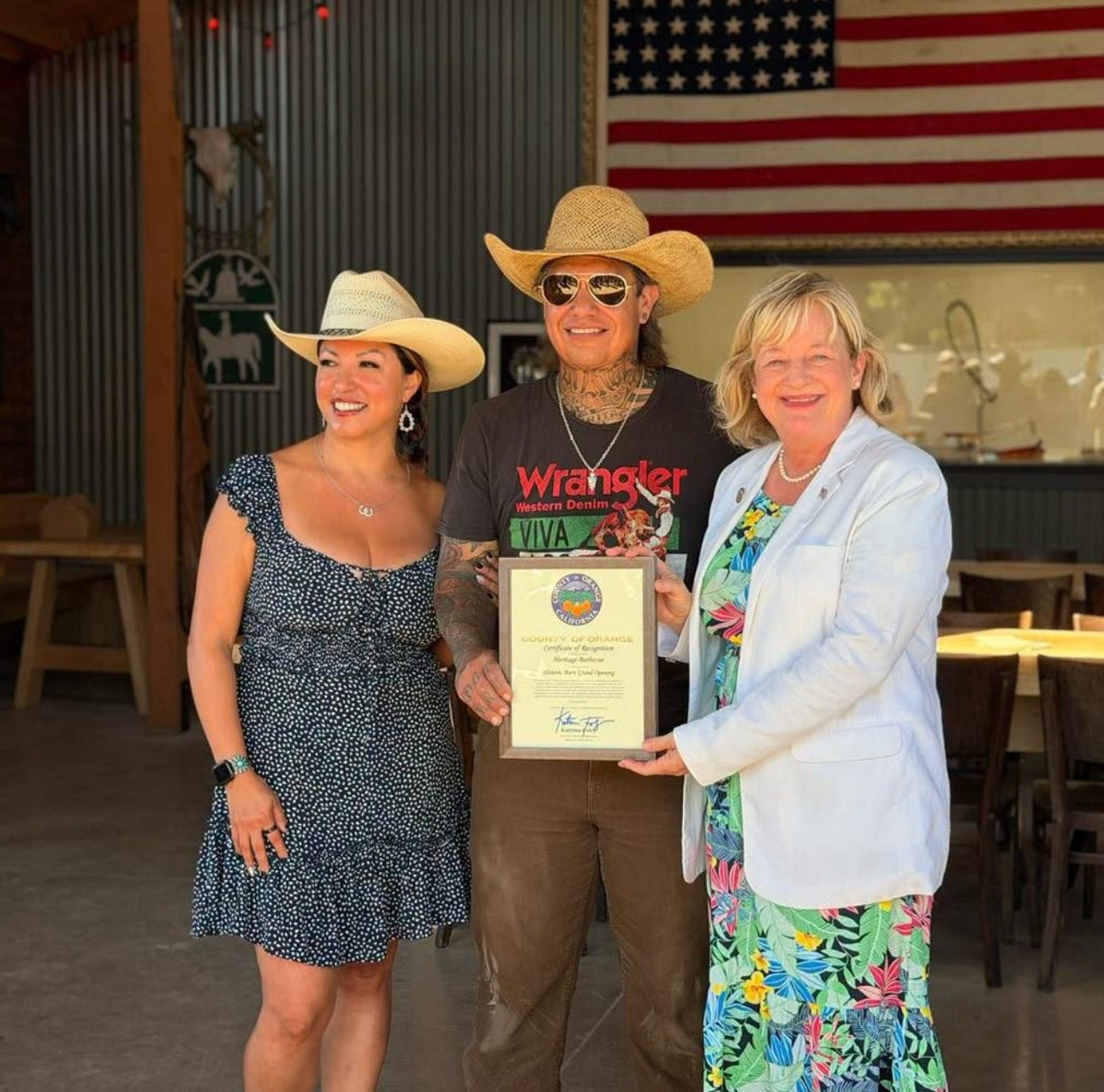
JEFF PEARLMAN: “And why’d you go to UCLA?”
KATRINA FOLEY: “I always wanted to go to UCLA. It’s like my dream school. I got into UCI out of high school and I declined. I didn’t know anything. I was dumb. I said, ‘Why would I? I don’t want to live in Orange County.’ And then I ended up making my whole life here.”
JEFF PEARLMAN: “You got into UCI, but didn’t go?”
KATRINA FOLEY: “I went to Santa Barbara City College for two years. And then I went to UCLA for three years because I did a double major.”
JEFF PEARLMAN: “Besides the traumatic upbringing you experienced with a shitty stepfather, all that … what do you feel like steered you to actually entering politics? Was there a moment?”
KATRINA FOLEY: “So this is the dork that I am. When I moved here after law school, my husband is from Costa Mesa. But I didn’t know one person. I didn’t know one lawyer. I knew my husband’s high school friends, that’s it. And his parents. And so, I said, ‘Oh, what can I get involved in where I can meet people?’ It was 1997. And there was a woman, Libby Cowan was her name. She was running for re-election to the city council.
JEFF PEARLMAN: “Some people take up bowling or knitting or theater.”
KATRINA FOLEY: I know. Yeah. And so, she was one of the first gay elected officials in Orange County.”
JEFF PEARLMAN: “Libby Cowan?”
KATRINA FOLEY: “Libby Cowan. Yeah. So, I didn’t know that at the time. I just knew she was a woman running for a city council. And so, I sent my resume and I was like all official. I did a fax. I did a fax! And then she called me and she says, ‘Well, okay. I’m going to hire you.’ I go, ‘Really? Okay, that’s so great.’ She says, ‘And the pay is nothing.’
JEFF PEARLMAN: “I’m in!”
KATRINA FOLEY: “I had so much fun meeting all the people. And then the planning commissioner position came open and I thought, ‘Oh, I could use my legal skills.’ And I used to live in West Los Angeles near Third Street Promenade when they redid Third Street Promenade. So, they were redoing west side Costa Mesa. That was the discussion at the time. I thought, ‘Oh, I have lots of great ideas because I just came from West Los Angeles.’ So, I applied and I got appointed and the rest is history.”
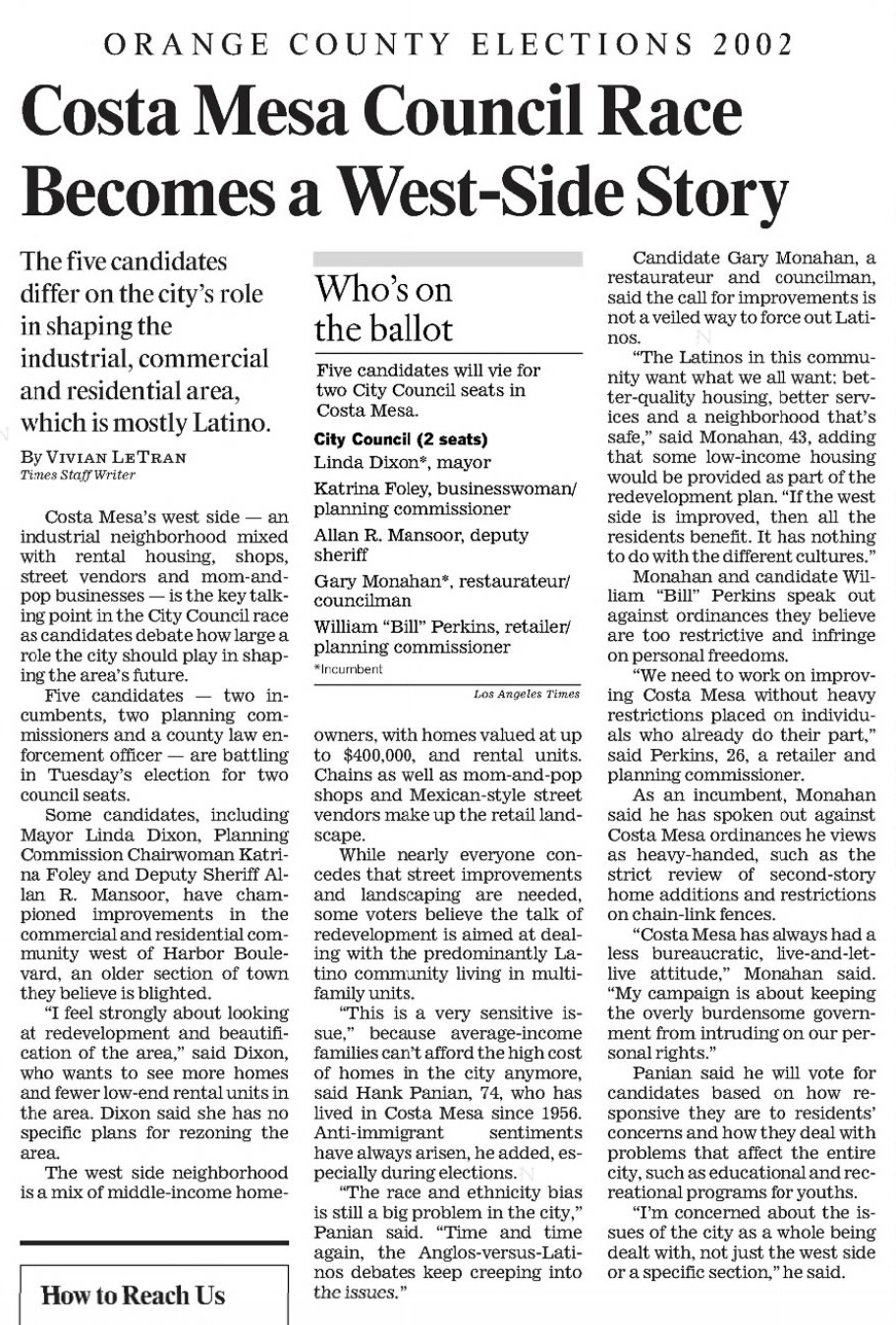
JEFF PEARLMAN: “In 2002, you lost in the Costa Mesa City Council race. And that was your first election. What happened?”
KATRINA FOLEY: “Well, first of all, I learned that running on a platform of ‘Costa Mesa needs a strategic plan’ is not a very good campaign.”
JEFF PEARLMAN: “Why is that a bad campaign?”
KATRINA FOLEY: “It doesn’t relate. People don’t relate to that. We did need that, and we ultimately did do that. But people want you to fix their potholes. They want you to beautify the neighborhood. They want you to make sure the schools are good. The traffic is reduced. Storefronts are open. Strategic plan, no one knows what that means. It doesn’t resonate. So, it was a bad campaign slogan. Or not slogan, but platform.
“And then additionally what I learned was you have to get every endorsement in writing because I never ran for office before. If someone signs my nomination papers, I don’t know about you, but I would think that that person supports me running for office because I would never sign someone’s nomination papers that I don’t support. Well, apparently my neighbor didn’t support me, but he signed my nomination papers, but I didn’t know.”
JEFF PEARLMAN: “And did that come back to bite you?”
KATRINA FOLEY: “Yeah, yeah, because he said he didn’t support me and I had him listed and they used this big headline. So, I learned, okay, you have to get stuff. You have to tighten it up a little bit. So, I learned from that. I learned a lot. I wasn’t partisan at that time. I didn’t have identity as a partisan person.”
JEFF PEARLMAN: “Were you registered as a Democrat?”
KATRINA FOLEY: “Yeah, I’m lifelong Democrat. But it wasn’t relevant for me to the job. I wasn’t involved in the party. And that was the issue. That began—sorry, Costa Mesa—but that began the time in Costa Mesa where everything turned partisan because they wanted to take me out and never let me get elected. And they decided to always use partisanship as the way to do it. So, in 2004, I won and I kept winning.”
JEFF PEARLMAN: “Wait, I want to ask you a question before you go on with that. When you’re you and you’re just like this nerdy political person, and you have this first, not just a loss, but almost like a lesson that like, ‘Oh, politics is ugly and sucky and blah, blah, blah.’ How does it not in a way deter you from pursuing this to that degree?”
KATRINA FOLEY: “It’s a really good question. I don’t even know the answer to that question. I guess I’m tenacious is the only way I could describe that. I don’t like to give up and I certainly don’t like to lose. And so, if I’ve lost something, I try to win it some other way. That’s what I did.”
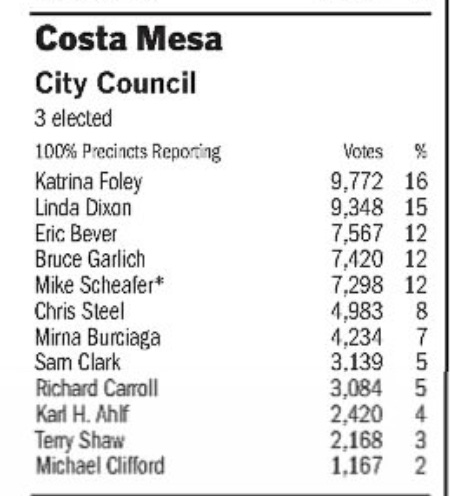
JEFF PEARLMAN: “So, when you came back and won two years later …”
KATRINA FOLEY: “I got the most votes in the history of the city.”
JEFF PEARLMAN: “What did that mean to you?”
KATRINA FOLEY: “Well, it meant that there were things we did wrong in our campaign that we corrected. I had a campaign consultant. I changed the whole way I did it. I was more professional in how I ran the campaign. I ran it more less like I’m the neighbor running and more like a real campaign.”
JEFF PEARLMAN: “You ran a tougher operation?”
KATRINA FOLEY: “One of my faults is I don’t like losing.”
JEFF PEARLMAN: “Are you actually like … if you’re at home, I don’t know, with the husband playing chess, you’re kind of an …”
KATRINA FOLEY: “I don’t like losing.”
JEFF PEARLMAN: “Really?”
KATRINA FOLEY: “We have a funny story. It’s probably not that funny to my friend. So, my boys have grown up very competitively. We never let the boys win. Even in little basketball hoops, we try to win, and card games, whatever. So, that’s what I was used to. So, my friend is visiting from another state and she has her stepson with her and he’s like 11 and we’re playing some card game. I don’t remember. And I won the card game and I’m like, ‘Yay, I win.’ And he just got devastated. I go, ‘Oh, my gosh, I’m not used to this.’ We’re very competitive at our house.”
JEFF PEARLMAN: “And that translates into politics, I imagine.”
KATRINA FOLEY: “Probably. I’ve had to fight for my whole life, so it’s just a part of my nature.”
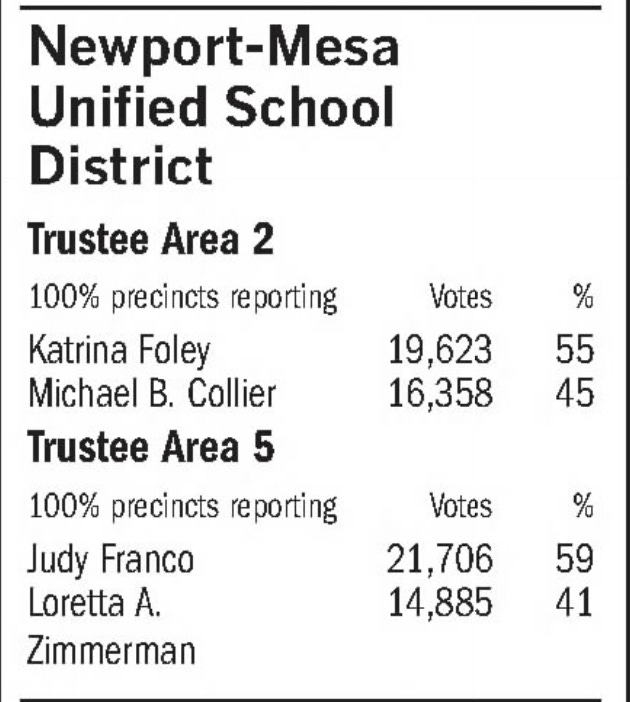
JEFF PEARLMAN: “The year is 2010. Newport-Mesa Unified School District Trustee. Again, who would want this job? I’m not trying to be a jerk, but …”
KATRINA FOLEY: “Oh, I had a very specific reason. I left my council position because my kids were going to go into the high school within the next two years, the junior high. And all of the families in the neighborhood were leaving our local high school and going to Newport and Huntington Beach. And we pay a lot of money in taxes. We should be able to go to the neighborhood school.
“And I toured the school and I was appalled. The locker rooms were horrific. It was really dirty. It was gross. There was facilities that were degraded. The football field had pothole things in it. You’re going to break your ankle running out there. And so, I came home and I said to my husband, ‘I don’t know. I don’t know how we can go to that school.’ And so, I decided to run for school board to fix it.”
JEFF PEARLMAN: “Did you?”
KATRINA FOLEY: “Yes. We built a new stadium and a new theater, science labs, a new middle school. We had an increase in the neighbors that went to the school. They did not, the counselors and others, they did not encourage kids to go to college. We turned it into a college going culture there. We added STEM programs, dual immersion programs. So, in a very short time, I did a lot.
“And I used different schools as models. Corona Del Mar was an example. They had a whole science budget for their science classes, and they had the baseline of what they needed to add to what the school district was providing in order for kids to get the materials they needed for quality, that level of science, biology, et cetera. But they could just ask all the parents to donate to meet their budget. Well, Costa Mesa, those parents can’t all donate like that. So, I started advocating to increase the science budget across the district to be able to buy basic supplies, beakers, whatever the protective glasses are called ...”
JEFF PEARLMAN: “Goggles?”
KATRINA FOLEY: “Goggles. Thank you. Whatever they are. And you would’ve thought I’m asking for every student to get a Rolls Royce. It was ridiculous how much pushback I got. We ultimately got it done. But yeah, so we did a lot of good in that short period of time.”
JEFF PEARLMAN: “What do you feel like you understand about problem solving that maybe other people don’t?”
KATRINA FOLEY: “I don’t think I have any better understanding. I think that people are conflict averse.”
JEFF PEARLMAN: “Are you not?”
KATRINA FOLEY: “I don’t like conflict. I don’t want conflict, but sometimes it’s unavoidable. But what I know from working as an elementary school PTA president, junior high, high school PTA, booster, foundation president, most parents are conflict averse. So, when you have parents in a school that’s socioeconomically disadvantaged and they don’t have time to be in conflict with the administration over something that they think they need, so they just don’t say anything. So, then nobody’s saying anything. So, I feel like I’m willing to step into that space that is uncomfortable in order to make something better happen.”
JEFF PEARLMAN: “I would say it’s very interesting moving here from New York. In New York, you’re very like, ‘What the fuck is your problem?’ or, ‘Why can’t we just talk about this?’ And in California, especially in Orange County, it’s very like, ‘Well, I know this is awkward, but I just, if you could maybe...’ And I feel like people who are blunt walk pretty freely. It’s a much better way to be here because people are not nearly as blunt as they are on the East Coast. You disagree? You do have a New York thing about you. In a good way, not in a bad way. I swear to god, you definitely have a New York thing about you.”
KATRINA FOLEY: “Well, good because my son is moving to New York next week. He got into the Parsons. So I’m going to get to know New York.”
JEFF PEARLMAN: “That’s awesome. Congrats.”
KATRINA FOLEY: “Thanks. I’m very proud.”
JEFF PEARLMAN: “Let me throw some rapid fires at you, okay?”
KATRINA FOLEY: “Mm-hmm.”
JEFF PEARLMAN: “How convinced are you or how convinced should we be that RoundUp pesticides, et cetera, actually cause the damage that people believe it causes?”
KATRINA FOLEY: “Oh, I think that RoundUp and pesticides, I mean, look, the state of California has banned paraquat, which has been being used in agricultural areas because it’s dangerous to the health of our residents. I am convinced that RoundUp and other pesticides hurt our health. Do I have evidence of direct causal link between RoundUp and a person having cancer? No. There’s a lot of environmental factors probably that come into play. But any toxic chemicals being routinely used in the community is hurting our health. I am convinced of that. And I will try everything to reduce the amount of chemical exposure that we have as residents.
“And right now, what we’ve been doing is just routine spraying everywhere. I mean, look around all this manicured area. It’s because of routine spraying. It’s convenient, it’s low cost, but in the end, it’s actually more costly because it costs us our health. And I’ve had this position for a long time, not changing my mind.”
JEFF PEARLMAN: “I don’t really get it. There are things I don’t understand in this world. People who are against, who say, ‘Well, climate change isn’t real.’ And I’m always like, ‘But you breathe the air too. You breathe the same air I breathe.’ Why are there colleagues of yours against your position?”
KATRINA FOLEY: “That’s just politics. That is just politics.”
JEFF PEARLMAN: “Why doesn’t it drive you freaking crazy?”
KATRINA FOLEY: “Well, of course, because I like to solve problems. All of the different things that people want to fix, the sand erosion, the king tide, impacts from the king tides, all of that is because the planet is changing. I mean, that is why. So, people who don’t believe in climate change believe that that’s a problem. So, I’ve just tried to change the way we talk about it and talk about it from, okay, it’s economically better for us to address these issues.
“And it saves us money to go solar. It saves us money as taxpayers to be electrified in our fleet and not rely on fossil fuels for gas. It saves us money to not have to use heat and air so much because the buildings aren’t built the proper way or the materials that we use for building aren’t sustainable. So, it saves money. So, if you don’t believe in climate change, if you think that’s a hoax, but you do believe that you don’t want your taxes to be wasted, okay, that works for me.”
JEFF PEARLMAN: “How concerned are you about the Big Beautiful Bill and the just hammering away at programs like CalOptima as far as being able to fund it?”
KATRINA FOLEY: “Extremely concerned. Our county budget is wholly dependent on federal and state funding. We have 83 percent of our budget is mandated program funds. So, what a Big Beautiful … ugly bill, excuse me, did was eligibility workers have to be hired to process the applications for people who need CalOptima and who need for health insurance and who need CalFresh for food. So, the people who are eligible for CalOptima, let’s say an individual, $18,800 a year. That’s how much you can make. So, think about that. That’s a person who’s very poor in Orange County when the average income is $100,000.
“So, we now have to re-certify all of these individuals two times a year. Not only do we have the added work of twice a year re-certification, but in addition, we have all these new work requirements and volunteer hour requirements that we have to make sure that the clients are complying with. That takes time. That means we have staffing needs. You can’t do it without staff.
“But then they cut our budget 25 percent. So, they cut our budget in half. It used to be 50 percent paid for by the feds. Now it’s 25 percent. So, double the work, half the money. We already have seen about 70,000 people fall off of CalOptima this year since all of the changes went into effect. So, they’re projecting that we’re going to get to somewhere around 200,000 people that are going to need indigent care. And I’m getting really wonky here.”
JEFF PEARLMAN: “Bring it.”
KATRINA FOLEY: “Okay. So, in California, the counties are responsible under the Welfare and Institutions Code for paying for individuals who do not have insurance if they go to the emergency room or if they have an emergency. Prior to the Affordable Care Act, we had about 750,000 individuals that the county was responsible for caring for when they go to the emergency room or when they have a medical need.
“Right now, today, well, maybe it’s changed today, but last time I got briefed on this a month ago, 20 people. It went from 700,000 to 20. So, we don’t have a hit. However, all these new changes are going into place this year. They are projecting we’re going to get to indigent care about 200,000 people. We don’t have a funding source to pay for it other than the general fund, of which we don’t really have any discretion over because there’s backfills that we have to use from the general fund to cover the mandated state programming that’s unfunded. So, it’s just a nightmare.
“And we’re seeing in the food banks, the increase in the number of people going to the food banks is dramatic. Claudia tells me this from the Second Harvest. She says it’s close and it will be, by the end of the year, pandemic-time food assistance, which we’ve never before seen anything like that. So, now we’re looking at a pandemic response for food insecurity when we’re not in a pandemic just because people don’t have a way to pay for food.
“The economics of that is also important. I always go back to the economics because people maybe don’t think about it. But if I give you an EBT card and you go buy groceries in the local grocery store, you’re supporting the local economy because you’re buying food. And so, we’re going to lose all of that benefit as well. So, it’s a real problem and it was a big mistake.”
[The waiter approaches. I insist I’ll take the check.]
JEFF PEARLMAN: “I’m paying, by the way.”
KATRINA FOLEY: “No, no, no.”
JEFF PEARLMAN: “No, I have to.”
KATRINA FOLEY: “You can pay for yours, but you can’t pay for mine.”
JEFF PEARLMAN: “Why?”
KATRINA FOLEY: “The gift code is $5.”
JEFF PEARLMAN: “Is that true?”
KATRINA FOLEY: “Yeah. County of Orange has a special-”
JEFF PEARLMAN: “Even if you’re being interviewed?”
KATRINA FOLEY: “Yeah, I don’t know. I just pay for my own.”
JEFF PEARLMAN: “The journalistic code is you can never let someone pay for you.”
KATRINA FOLEY: “Yeah, you pay for yourself, I’ll pay for mine. Win, win.”
JEFF PEARLMAN: “Fair.”
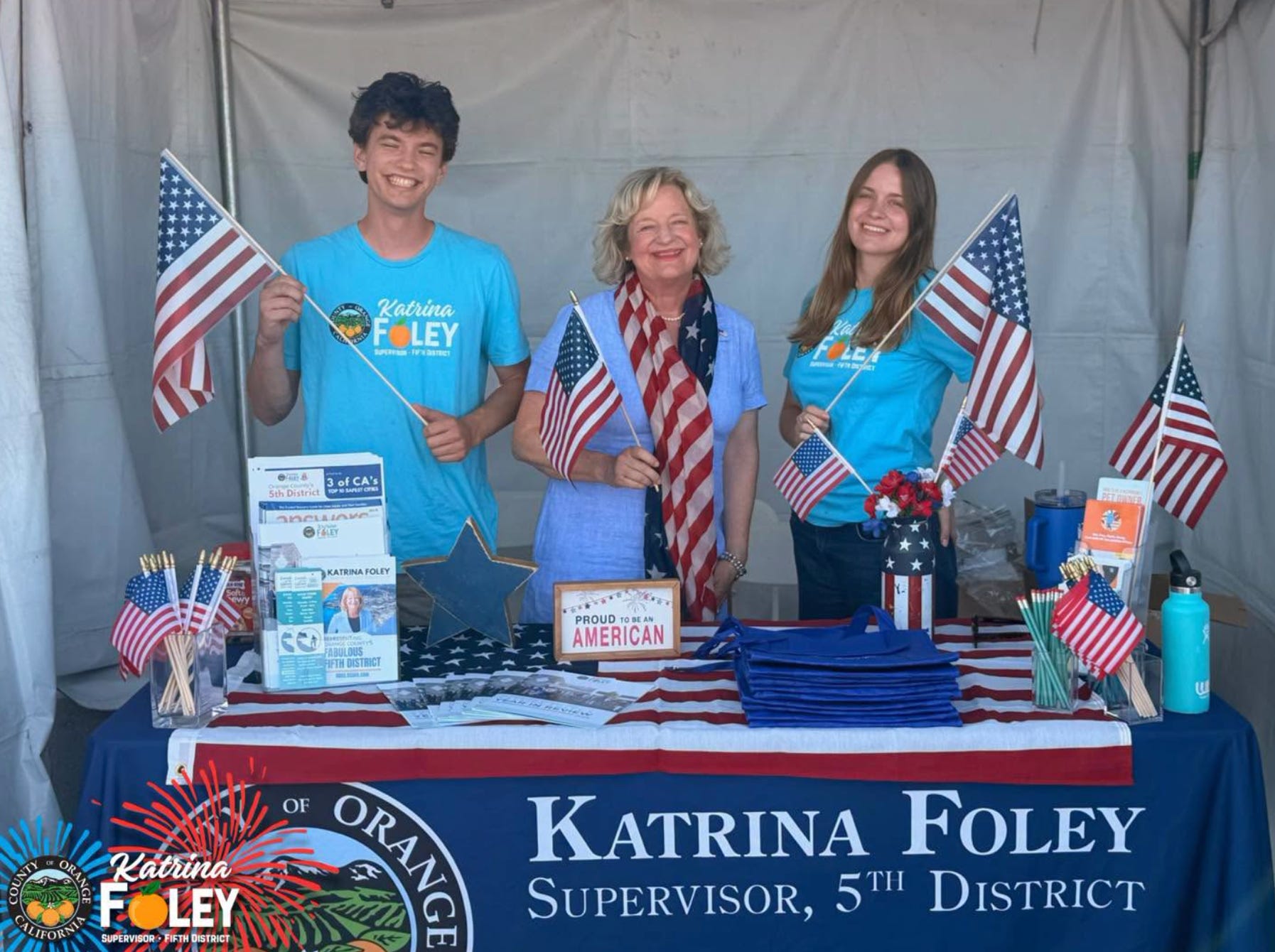
KATRINA FOLEY: “Let me just add one more layer the the impact of this all. And I’ve asked for which schools this will impact. In Orange County, we have a lot of schools that are on the free lunch program. And they just made the whole school is eligible for free lunch because there was more than 60 percent of the students were free lunch eligible, so they just made the whole school eligible.
“Now the feds are saying you cannot do that. So, they’re going to start just taking away all the eligibility for the whole school. And then individuals have to start applying individually again. So, that creates another problem. And for me, look, everything always comes back to. I never forget where I came from. If I didn’t have the free lunch program, the free breakfast program when I was a kid, I might not eat on a day. I ate breakfast at school, I ate lunch at school pretty much until I was a senior in high school when I could go off campus and eat whatever I want. And so, those are really important programs. The fuel that you get for your brain when you’re at school helps you to get smarter and have a better life.”
JEFF PEARLMAN: “So here you are and you’re running. And your opponent is Diane Dixon. And they come along and they say, ‘Katrina Foley sucks. She sucks and she sucks and she sucks and she sucks.’ And they don’t really offer any great solutions. I’ve read her campaign literature. I’ve seen the different things. They don’t offer any details, any solutions. They just say, ‘Foley sucks. Foley sucks. Foley sucks.’ Do you feel like you just have to take it to a certain degree? This just comes with this job?”
KATRINA FOLEY: “Look, it’s going to be very different in the general than it was in the primary. I mean, what’s important too, and I hope you will point this out. There were four, it could have been five, I think it was four opportunities for us to have a town hall, a debate, answer questions together in front of a crowd. She declined every single one. So, the first was Laguna Beach, the Laguna Voice, the radio station. She declined right before it was supposed to happen. So, then we had OC Tax. Okay. She’s like, ‘I’m Miss Tax Lawyer Against Taxes.’ Why wouldn’t you want to do that debate?” She refused to pick a date. Then—Speak Up Newport. This is her home base. And the guy that runs it is a former mayor of Newport. He sent me a text, he gave me a date. I said, ‘She’s not going to do it.’ He replies, ‘Oh, no. She will.’”
JEFF PEARLMAN: “You actually said she’s not going to do it?”
KATRINA FOLEY: “Yes, I have the text. I said, ‘She’s not going to do it, Ed.’ And he said, ‘No, she promised me she’s going to do it.’ I go, ‘Okay, you let me know when you have it confirmed because I’m going to predict she’s not going to do it.’ And then he went about organizing it and everything, and then sure enough, she canceled.
“And then what was the third? Oh, the realtors. Laguna Beach Realtors. There was a forum and we got the questions in advance. We got all the questions in advance. It wasn’t going to be hard. It’s just a matter of us getting up in front of people and answering these really basic questions that any of us should be able to do without notes. She wouldn’t do it. All of these, except for the OC Tax and Speak Up Newport, they just canceled it all together. But the other ones, I just went by myself and answered all the questions. So, this time we have now supposedly on calendar OC Tax a forum, but I don’t think she’s going to show up.”
JEFF PEARLMAN: “You really don’t think she’ll go?”
KATRINA FOLEY: “No. She will barely be in a room with me.”
JEFF PEARLMAN: “Have you met her? Do you know her?”
KATRINA FOLEY: “Oh, yes. We were friends. All these initiatives that she has been getting through the state, these were things that I helped her with. And I worked with my Democrat colleagues at the state level to help get her through. The sober living home reform, the e-bikes. These are all things that we were working together on. And even when she called me to tell me she’s running, I’m like, ‘Why are you giving up your seat?’”
JEFF PEARLMAN: “Wait, she called to tell you she was running against you?”
KATRINA FOLEY: “Yeah.”
JEFF PEARLMAN: “She called to tell you?”
KATRINA FOLEY: “Yes.”
JEFF PEARLMAN: “That’s courtesy in a way, I suppose. I don’t know. That’s weird.”
KATRINA FOLEY: “Yeah. She said, ‘Oh, it’s going to be a friendly campaign.’ I go, ‘Well, it’s already unfriendly even before you’ve called me, and so I don’t see how that’s going to happen.’ I said, ‘The Lincoln Club’s already starting to attack me.’ This was before she even actually filed. And she’s like, ‘Oh no, we’re just going to keep it related to the issues.’ And I said, ‘We’ll see about that.’ Of course, that’s not what happened. Even her own mailers were aggressively anti-Katrina Foley. She put pictures of me looking very unattractive and claiming that I’m paying with my district funds for sex change operations for kids. And that’s just outrageous to say that.
JEFF PEARLMAN: “That’s the new boogeyman.”
KATRINA FOLEY: “I know.”
JEFF PEARLMAN: “Or you’re a communist. She’ll get to that next week.”
KATRINA FOLEY: “Oh no, that was in one of the mailings. Also, I’m going to defund the police. I’m going to go to jail. I’m corrupt. I mean, all these crazy things that are coming on her committee, not a third party. So, she’s a liar.”
JEFF PEARLMAN: “I want to ask you a final question. Because I ask most people this. I mean, these are depressing times we live in. We have a freaking nut job as a president. We have all these people, these boon liquors. Do you think 10 years from now, we look back at America now and we think, wow, we survived this really crazy, awful time. Or do you look back, do you think 10 years from now we’re like, that was the beginning of the end of this amazing Democrat-”
KATRINA FOLEY: “Oh no. I’m going to say we survived. Are you kidding me? We’re going to see that in November. We are going to see a big turnaround in November because a lot of these bad policies that do not support Americans are now starting to impact Americans, even Americans who voted for Trump. And you’re going to start to see people just, they don’t want to be hurt anymore. They don’t want their gas to be so expensive. I don’t do grocery shopping. My husband does, and I even have noticed, because I see the bank statements, I’m like, ‘Oh my gosh, what did you buy at the grocery store?’ He goes, ‘I bought the same thing I always buy.’”
JEFF PEARLMAN: “No doubt.”
KATRINA FOLEY: “But do we survive? Of course we do. We survive, because we fight for America.”
#TOC
This was a fantastic interview Jeff. I was already going to vote for Katrina, but I have a much greater appreciation and understanding of her now through this interview. She is outstanding and exactly the type of person we need representing us. I will enthusiastically support her up through the election.
I am so happy whatever misunderstanding that happened was cleared up and you had a chance to sit with this awesome public servant. This is who we need to protect us from the bumbling bullies who are upending society. Can’t wait to cast my vote for Katrina Foley.