
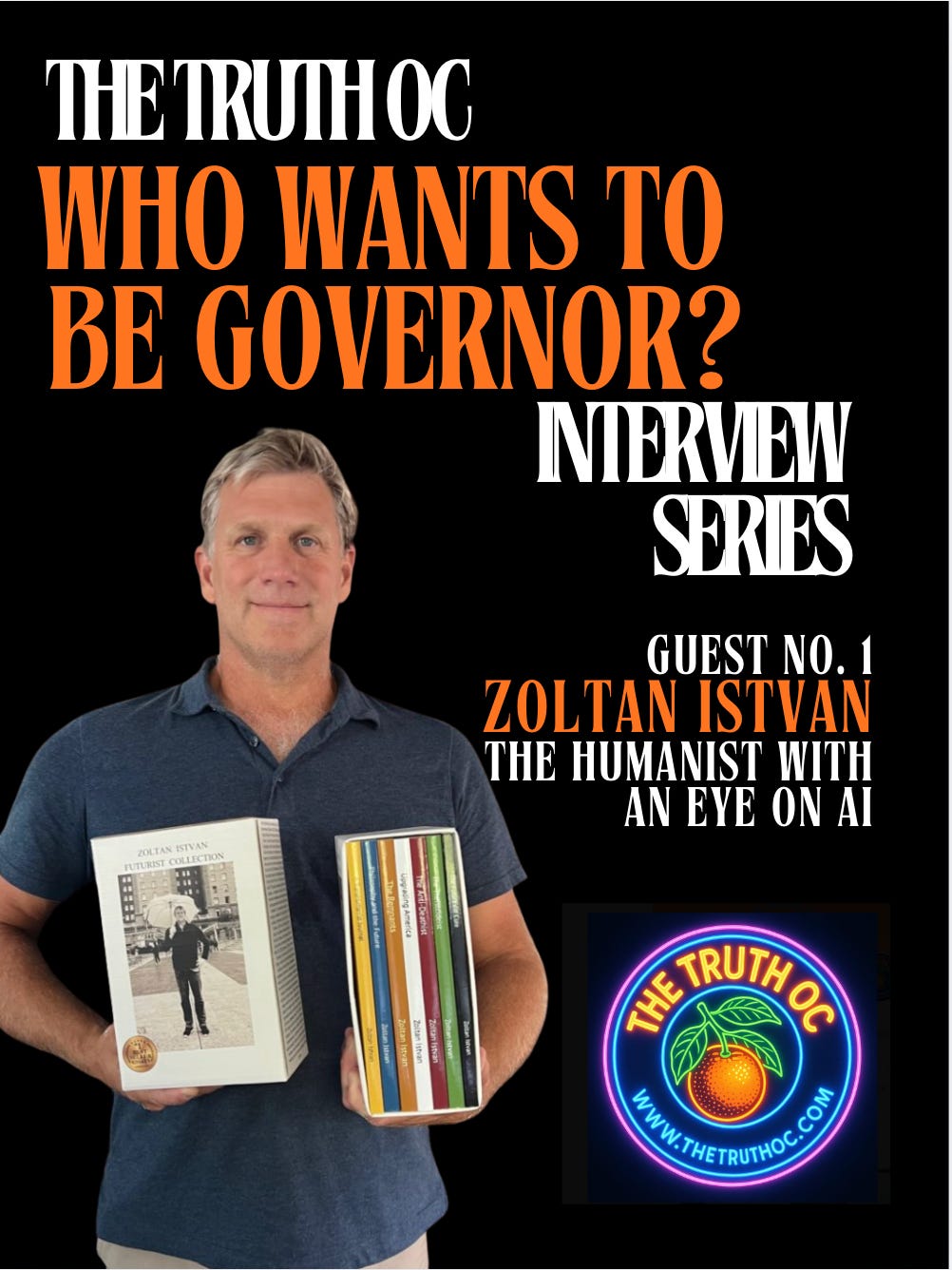
So over the past few weeks I started reaching out to every single candidate for the upcoming California gubernatorial race. I’ve contacted Democrats and Republicans, Green Party members and Independents. And my goal, truly, is to feature every single (willing) participant in a Q&A in this space. I am not here to insult people I disagree with, or hype up people who share my beliefs. I want to hear their views, their takes, their motivations for seeking a powerful-yet-frustrating position.
And then, I want to share it with you, the Truth OC community.
So (drumroll, please) …
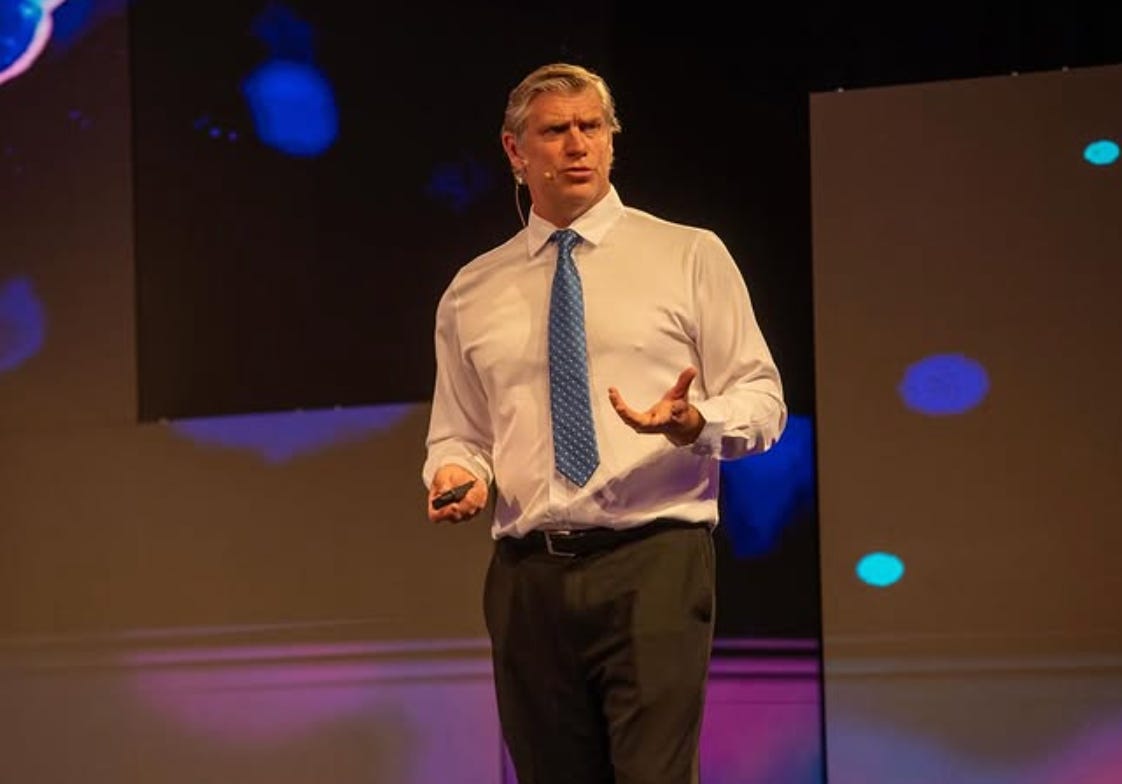
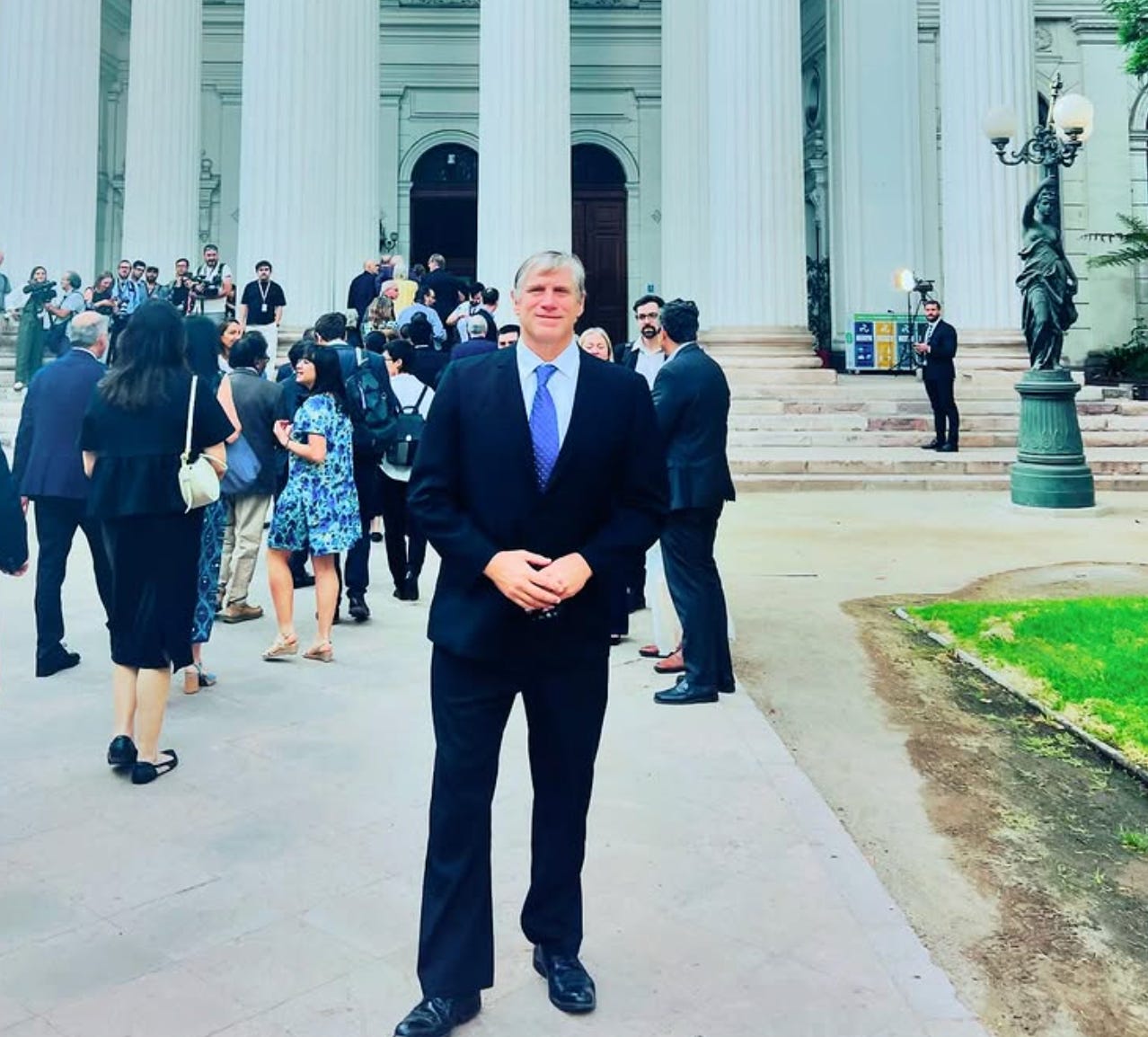
I bring to you Zoltan Istvan, a candidate for governor who is no stranger to elections. In 2016, he, ran for president on the ticket of his own Transhumanist Party. In 2018, he ran for California governor as a Libertarian. Then, in 2019, he ran for the Republican Party’s presidential nomination against Donald Trump. Now, he’s trying to head our state—as a Democrat.
To Istvan—a Los Angeles native, former National Geographic reporter, former nonprofit director, current owner of myriad worldwide vineyard properties—this has never been about party, but enlightenment. He identifies as a proud and unapologetic transhumanist—aka: the belief in improving human individuals via science and technology. He also thinks we, as a species, are utterly unprepared for the AI reckoning that is upon us, and that politicians of all stripes are missing the mark on an existential threat.
I spoke with Istvan over Zoom this past Sunday. At the time, he was uncertain whether he will remain in the race. You can learn more about the man and his campaign right here, and you can donate to his run here.
Also, I have posted the full video of the interview below, and typed out the transcript.
Ladies and gentlemen, meet Zoltan Istvan …
JEFF PEARLMAN: “Well, first of all, thank you for doing this obviously, I appreciate it. Lemme ask you first, because when I reached out to you, you had some, I guess some doubts or you were kind of debating. Are you still running or have you decided not to run for governor this time around?”
ZOLTAN ISTVAN: “Well, I’m definitely still running for California governor. We are having some doubts. We’re in some final stages of trying to raise money and I’m worried that if we don’t raise that money we won’t be able to continue. But the registration date for officially declaring is I think March 6. So we still have a few weeks to that kind of point.”
JEFF PEARLMAN: “So why would one decide to even try running for governor when it is number one, as you’ve said in the past, kind of a long shot bid; and number two, kind of a thankless job. Why would one even want to run?”
ZOLTAN ISTVAN: “To be honest, I think for me, the main reason I decided to run was because artificial intelligence is posing such a huge threat right now to not just California, but to United States and the world and none of the other politicians are talking about, and it’s my field of expertise as someone who’s been in it 15, 20 years writing about it. So I felt like there was a need for someone to represent that issue and that problem, and of course my solution for it is a universal basic income, which is something that I have been promoting and talking about since, in fact, even before Andrew Yang put it in the mainstream media.
“So I supported that and if I was on the ballot and you get your little line right underneath, you’d be like, BASIC INCOME ADVOCATE. And that’s really what I’m trying to do here. I feel like without that in the system, people don’t realize what kind of job apocalypse we’re going to have. I mean, I feel like it’s just 12 to 18 months away. My campaign might be a little early for addressing this issue right now, but it probably won’t be very early by 2027, 2028.”
JEFF PEARLMAN: “I’m always amazed, as we’ve seen right now, the absolute decimation of any climate protections, any remaining climate protections and people generally just going like, ‘oh, well what’s on TV? Who’s going to win the Super Bowl? Oh, what am I going to have for dinner?’ Do you feel the same? Like, ‘Oh, AI, this is great. I can create a funny cartoon of my head,’ and ‘Oh, I can look up a recipe for a tofu.’ Are you staring at all this thinking ‘You people don’t understand the reckoning that is coming’?”
ZOLTAN ISTVAN: "I think it amazes me that people don’t see what’s coming. There is a reckoning and you’re a hundred percent right in the sense that something major or something transformative is happening to the human race, not just the economy. This time we’re talking about everybody because, if AI takes 90% of the jobs and we’re talking about a depression on a scale the United States has never, ever seen in my opinion, we’re going to need to do something about it. But you have so many distractions. Netflix has their new series out or there’s a Super Bowl and everyone’s bashing Trump.
“Okay, look, I’m not a fan of the guy either, but the point of the story is what seems the most important thing to me in the world right now is that you train for a career for 15 years … let’s say you went to graduate school, something like that, and that career will no longer exist, and whatever training you have won’t really apply unless maybe you want to be a barista at a Starbucks, which probably isn’t going to work for you.
“The whole world’s about to be transformed and no one’s talking about it. And I’ll tell you why. It’s because any time a politician opens their mouth about this, they lose votes. It’s just … there’s no winning in this topic. That’s the problem here. And even talking about a base income, sure people like free money, but it also means you’re never going to ever have the opportunity to probably become very wealthy because the base income will kind of keep you right in place. Yes, you’ll have food and security and hopefully housing and things like that, but the American dream is lost. And so a lot of our campaign is trying to talk about rewriting or redefining that American dream, but nobody’s listening. Everybody’s just interested in whatever’s happening in the Super Bowl or whatever new scandal on the Internet. Social media has become a complete disease that distracts people from real issues. But capitalism is moving forward for better or worse, robots are coming for everyone’s jobs and I think a huge transformative change is going to be happening and it probably won’t be good for a few years until we have government step in and figure out how to run a new nation that uses automation from us every job.”
JEFF PEARLMAN: “How would a basic income plan work, and what is the direct correlation between a basic income plan and the rise and terrifying expansion of AI?”
ZOLTAN ISTVAN: “Well, let me just say first off that I support universal basic income, but it can be universal high income, it can be universal dividend income. It could be a whole bunch of different ways that you might kind of tackle the issue. But the point of the story is that you have to have something happen in the age of automation. So basically we have been predicting that 50% of California jobs would be replaced by AI and automation by the time the next governor’s term ends. So that’d be like four and a half years from now. And the problem is people are like, ‘Oh, I’ll just get another job’ or ‘I’ll do this’ or ‘It’ll never take my plumbing job.’ They don’t realize robots are going to be tied in with these AI systems, those robots are going to be able to do plumbing jobs, going to be able to do construction jobs, not just white collar jobs.
“So basic income gives you something I think, in addition to the welfare services, that would actually say, ‘OK, well let’s say it’s $11200 a month or $1,500 a month.’ In the best case scenario, it would at least be like, ‘Now hopefully I can rent something. Hopefully I have enough food, hopefully I can start paying for healthcare and things like that.’ It would just be in many ways a Band Aid to make it so that you can get by. Hopefully, though, there would be an age of abundance that comes from our artificial intelligence. Like our plan was to give a robot to every household over the first governor’s term, and these robots are going to watch your kids, cook for you, do dishes. This is already sort of happening. I mean, very rich people are starting to put robots in their houses right now and have them undo the dishwasher.
“So it sounds crazy to talk about it, but it is really happening much more quickly than people realize. So it’s very realistic. I think that within two or three years time, many California households—they’ll have a car, they could have a robot that actually does chores. But this will make your life easier. There’ll be more abundance, more time to do other things, and eventually these robots will be able to build your houses, do everything for you, work for you, things like that. And eventually we might come to an age of abundance where it’s not so much about income anymore, but more just these machines that do everything for you and that we don’t need so much. Now, that’s a little bit more high-line thinking and is still sci-fi, but what we’re really concerned about right now is this transition between the next four or five years where AI and robots take a lot of jobs that are out there, the majority of them. And what do people do in the interim to just get by and survive while the government’s wrangling with this real issue that humans are probably not going to be doing much physical or any kind of work for income any longer?”

JEFF PEARLMAN: “So whenever a new technology comes along, I feel like the point will be made by the people distributing the technology that, ‘Well, X will lead to Y. So with the expansion of AI, we will need more AI-related jobs. It will open up a new industry of AI … whatever, technicians, AI scientists, AI programmers. Is that just a stupid and mindless sort of viewpoint?”
ZOLTAN ISTVAN: “Well, it’s certainly not stupid or mindless, but it is definitely wrong. I mean, if you’re already looking like 99.9, well I guess 99%, let’s say 98% of engineers are now being outdone by AI. Some 98% of coders are now being outdone by AI, and that’s going to go to every single field here shortly. If architecture is 60% AI, probably by two to three months from now, it’ll be 70 to 80% AI. So it’s just getting so fast and so good. So there is no creation of new jobs. It may create something for a few months, but AI will catch up. And I’ve been saying this before, a lot of people are very upset about the H-1B visa issue and immigration, this and that, but you even had Hillary come out the other day say, well, maybe they went too far with immigration.
“Listen, the world is changing. I completely don’t support ICE, but I think people have to realize there is no reason to have immigration come into the United States or California anymore, because of there are not going to be any jobs. So even though I would support having all the people that are here become naturalized citizens and whatnot, I even have to say, ‘Wait a second—for a long time we were buffering our country by having immigrants come take jobs, make more money. It was great. That’s how America built itself.’ But at some point that’s going to switch to robots and the immigration’s going to actually be … how many more machines can you build? So there’s a fundamental dynamic, and I’m not trying to give you a moral issue here. I’m trying to just give you a philosophical thing that nobody seems to want to debate, that if all of a sudden I have vineyards, and all of a sudden robots can pick the grapes and do the vineyard business at half the price of labor, you have to ask yourself, as a business person, ‘What do I do?’
“Well, most business people are going to say, ‘I want the robots to do it, so therefore there’s no need for that job anymore with humans.’ And that’s happening all across the state, all across the country. And nobody wants to talk about this because it’s such a fire-point issue. But the reality is, the reality is that capitalism is making it so that we’re going to probably close our country up because there’s no economic way to help anyone anymore and they can’t contribute. And I wish people would at least try to start to think about this in those terms and not in terms of whether it’s right or wrong. My parents are immigrants, so they came here and I’ve always loved immigrants, but this is a different world we’re about to enter and I think it’s important that people discuss it openly. But I can tell you no, no one wants to talk about because it doesn’t win votes.”
JEFF PEARLMAN: “Okay. The argument has always been immigrants will do the jobs that people who are born here don’t want to do. So when you go past a field, people are picking grapes. Well, people don’t want to do that. Are you saying that AI is going to ultimately create machines that do those jobs, or are you saying that these jobs that American born citizens don’t want to do, their jobs will be replaced and therefore those jobs will have more value for actual human beings?”
ZOLTAN ISTVAN: “I think all jobs are going to be replaced. In fact, I wouldn’t be surprised if it’s closer to 97, 98 percentile. I can’t think of, looking at humanoid robot demonstrations now today, literally today thinking that any job is safe, maybe like soccer is safe, or maybe being you want to go to a specific coffee shop because you like humans that will probably remain. Humans doing yoga. Maybe you don’t want a robot teaching you yoga. That’s fine. But when you talk about anything white collar, when you talk about selling cars, when you talk about these things, if it’s more efficient and you’re going to save money to buy a car, the salesman can be completely taken out the equation. The whole thing is going to be shifting.
“Even you and I here, it’s like, look, I know you have resources and you, you’re trying to do interviews and things like that. I saw your website, it’s awesome. Actually, by the way, congratulations on doing some really amazing work, but probably within six months it’s already here. There’s going to be an avatar If you have something else, it’s going to speak your perfect language. You can do these interviews, I can do these interviews. In fact, this technology already here, if you want to explore it, it’s all out. There are multiple companies working on you and I doing stuff. So everything is switching. Even things that you think are human can be done through AI and automation like this interview. And once that starts happening and people realize that they can be sitting on a beach in The Bahamas playing guitar or surfing, there’s a good swell or whatever it is … I’m not sure that people are going to be in the loop whatsoever.
“So I think it’s not even about immigrants or the good jobs. I don’t think in the two-to-four year window any of that survives except maybe some of those very select categories. I told you where humans are, what is desired. You absolutely do not want a machine teaching you yoga. You want that human companionship, but again, the yoga studio down the street is probably going to be making a lot more money. So you’re going to have to counter that with a yoga studio that uses automation. The world is changing.”
JEFF PEARLMAN: “Do you feel for the better or for the worse?”
ZOLTAN ISTVAN: “That’s a great question. I was always hopeful. So let me just say campaigning out in the streets, people are totally concerned with affordability. And you in your second question, talked about the environment, which is interesting because I used to hear a lot about the environment, but nowadays I hear only about affordability. No one can afford anything. Everyone’s one paycheck away from homelessness. So I feel like a basic income could really be something that’s useful or a robot in people’s houses could make their lives easier. So life would get better, but the problem is that it also could get very dark very quickly. There’s the big thing where what if the Chinese robots are made in China and China does some kind of weird thing. You have a Chinese robot in your house going crazy.
“I mean, there are a million things that can go wrong. And so I worry that, well, I think I am optimistic about the future with machines and automation and robots. I’m also very concerned that we’re entering an era very similar, I think, to the Cold War where you’re constantly worried about not just a threat, but a cataclysmic threat, a life-changing threat. And I think that’s the problem here with AI is … the five year window, but the 10 year window involves super intelligence, which is almost like inviting something alien into our world that might be dramatically smarter than this, that might not want humans on planet earth. So there’s that whole era, too. I don’t speak about that much in my campaign because that really throws off people. But the truth is, I’ve been in touch with plenty of the Silicon Valley elites and they’re working on this. They’re actually very optimistic to see how far they could build out AI into something that’s much smarter than themselves. And that really worries me, too, because I just don’t know if I want something smarter than myself on planet earth.”
JEFF PEARLMAN: “Well, you’ve sort of gained a reputation for being one of the leading proponents of transhumanism, which is using science and technology to improve the human condition. Is this almost like where Frankenstein’s monster rises and Dr. Frankenstein, he’s like, ‘Wait, this isn’t what I was talking about!’ Has it gone fast …”
ZOLTAN ISTVAN: “That’s a perfect analogy. Look, I have taken a step back on my advocation for AI, that’s for sure. I still believe AI is really good for the world, robots and all that. But the problem is that it’s only good if it doesn’t become super intelligent. If it becomes super intelligent, then it becomes 50/50, maybe. The super intelligence is wonderful. It ushers us into this brand new scientific age. It takes care of human beings, it likes human beings. It brings in all these new ways to fix the environment, cure cancer, and do all that. Maybe that happens, but there’s the 50% other side where it says, ‘Oh, I don’t like you.’ It’s Terminator. ‘Get rid of these human beings that are using my resources, and I’m the smartest entity on planet.’ The human race has never dealt with a 50/50 existential risk.
“Even in the Cold War, it was still like 90/10 where well, we could always count on the Russians to not fire on us first and we’d not fire on them. We kind of had that as a basis. So the threat of nuclear war was probably never really that high, whereas with AI as super intelligence, we don’t know. So I think there is this really massive threat that we probably shouldn’t knock on the door of. But again, capitalism doesn’t allow for that. We’re constantly telling ourselves, well, we’re in a super intelligence race with China, with Russia, and we better get there first, but we don’t consider what happens when we’ve created something that’s even worse than China or Russia from a geopolitical point of view. And that’s very much where we’re going. And some of the coders that I’m talking to and programmers and a lot of it’s now done with AI are saying that that time is going to come probably by late 2027, 2028, when we have something that’s far superior to our human intelligence and with no means of controlling that.”
JEFF PEARLMAN: “I was wondering, does it get frustrating for you? Obviously you’re an intelligent man, you’re a learned man, you’ve studied this. Is it hard to have something you strongly believe in that you consider a threat to humanity and people just aren’t interested? And I’m not saying people aren’t interested in AI, but people … just like climate change where people just are like, ‘Oh, robots, come on … blah, blah, blah, whatever. This is ridiculous.’ Do you ever feel like you’re the guy screaming, ‘The asteroid is coming!’ and people are just looking at their phones?”
ZOLTAN ISTVAN: “Jeff, lemme be honest, it’s been a pretty emotional week because here I am potentially folding my gubernatorial run, which is based on what I would say is the most important threat to California and United States and the world, and nobody has been listening. Okay. We’ve actually had a series of pretty large interviews around the Dave Asprey Show and the Young Turks. So we got actually a lot of traction out there. I can’t even say that we haven’t been around because we’ve done pretty well. But what’s crazy is that it seems like major media won’t cover the issue whatsoever. They don’t want to talk about AI. Nobody wants to talk about not just AI and job loss, which is in itself a huge massive issue, but they don’t want to talk about the super intelligence possibility, that catastrophic existential risk. It doesn’t do well with voters and it doesn’t do well with viewers.
“It’s like the Titanic. Nobody wants to see the iceberg and it’s just going to hit it and drown a lot of us until it’s too late. And it’s been incredibly frustrating. I thought when I started this campaign, it was going to be like, ‘Okay, I might not win, but at least I would bring it to the forefront of the attention of everyone in California and hopefully the United States.’ And that has, even if I have gotten quite a bit of media attention, nobody’s really cared. And it’s been shocking to me and very depressing. I’ve got to be honest—nobody wants to listen and we don’t really know what to do.”
JEFF PEARLMAN: “I used to write for Sports Illustrated, and when I first got to the magazine, if you wanted to do a 5,000-word story about golf in Greenland, and it was a good story they would send you because it was a good story. Somewhere along the way, Time Life merged with AOL and blah, blah blah, and it all became about money, money, money. ‘We can’t do this because it’s not worth it. It’s not going to pay the bills.’ And I feel like when you say media isn’t covering this well, I feel like the corporatization of media, the consolidation of media, the unwillingness to anger advertisers, et cetera, et cetera … a message like yours gets lost, because they’re going to say, ‘Well, what is in this for us financially? What is the gain of telling this story of a long-shot governor candidate with some ideas about AI? What’s the payoff for us?’ And I think that’s what screws over people like you in 2026 …”
ZOLTAN ISTVAN: “Yeah, and I totally agree with you, and I just feel like we’re in this world where if you can’t go viral or if you can’t get a message out, then you just can’t make a difference. So we have been banging our heads against door, man. This is the tenth month of my campaign almost finished now, and we have been at it 24 hours a day. I mean, this has been my life. I haven’t done anything. And even on college campuses, which is where we’ve been targeting a lot of people, the younger kids … the professors are not telling them. They’re studying marketing and they’re studying engineering and coding. And the professors say, ‘Don’t worry about AI, you’ll figure it out. It’ll help you with your job.’ And I’m like, no, no, no. It’s going to replace your job and you’re going to hit the world at 22 with college debt and no work ever again.
“Like somebody isn’t telling you the truth. And of course they’re not telling the truth because the professors probably realize their jobs are limited. The journalists realize their jobs are limited. Maybe even the CEOs realize their jobs are limited. So it’s just such a hard topic to talk about because it doesn’t do anyone good in the interim, but the truth is, it’s probably the most important message we have to be spreading out there right now. The point is, we can’t just let this happen and all of a sudden one day we wake up, the markets are off 40% because we realize 25% of jobs are going to be lost in the next 30 days and then another 75% over the next 12 to 18 months. This is not a way to run the country. What we need is someone to say, ‘Wow, we have a problem. We have to define how far we’re going to take this AI. Maybe we need to make some kind of agreements with China where we don’t develop a super intelligence. We all try to just go hand in hand.’ I mean, this is bigger than countries. This is an overarching theme of whether humanity will survive the AI onslaught. And nobody wants to think of it in terms like that. They’re just like, ‘Let’s make money right now …
“And lemme just say too, you brought up the idea with the environment. This is exactly a good case, the environment, A lot of people weren’t paying attention to temperatures rising, and all of a sudden they did start rising. Except the only difference is that the environment, you actually had a 10, 20, 30 year runway before something potentially really bad happened. But the AI thing is crazy because it’s probably a 12 to 18 month runway unless something changes and still nobody wants to talk about it. So humans have a problem with this. They have a problem of forecasting what could happen, even if it’s in their best interest, and maybe that’s a class that needs to be taught in grade school. I don’t know what it is, but I wish more people would be thinking, and I’m grateful that having me speak to you because at least we’re getting a little bit of the word out. But I mean, it’s going to hit one day and then everyone’s going to be like, why didn’t we do something? And that’s too late.”
JEFF PEARLMAN: “I actually think we are basically the plot of a superhero movie, which is this, if you have the asteroid five feet from earth, we’ll do everything to blow up the asteroid. But if it’s a year and a half from earth, meh … it’s probably going to go a different way. We don’t have to deal with it. We are terrible at collectively dealing with long-term problems. It’s actually an indictment of our species as a whole.”
ZOLTAN ISTVAN: “Yeah, I fully agree with you. That is one of our fundamental flaws. And maybe one day if we upload our brains or something crazy, we will correct that because then I’d be, like, I mean, a machine would never think like this. A machine would be like, ‘Oh wow, we have a problem. Let’s start working toward fixing the solution.’ But we’re on the Titanic. I really think, and that’s just one of the beautiful things about humans is that they are this kind of passionate creature that just lets things go and we’re kind of all in a big giant dance, but it’s also a great flaw of ours that we let things go until they’re too far and then they harm us.”
JEFF PEARLMAN: “I’m going to throw a few quickies at you, but feel free to take as long as you want on ‘em. In 2018, you ran for governors as a libertarian. And one of your quotes was, ‘As a governor, I would declare aging a disease and put funding into stopping aging.’ What’s your beef with getting older besides the fact it sorta sucks?”
ZOLTAN ISTVAN: “Yeah, I mean I still do that. And that’s been a huge campaign promise. And in fact, a lot of the funding that we have had has come from people in that field. We would love to create a kind of a California governmental body, sort of like they did with stem cells, multi-billion dollar body that would be focused on curing aging. We think aging is perhaps the most traumatic thing next to AI coming that’s happening right now to the human race. And who wants to die? It’s not even who wants to age, because nobody wants to get 70 or 80 years old. If we could keep everyone in their thirties or forties or fifties or at least give them that choice, that would be wonderful. It’d be probably helpful for a lot of creativity in the economy and things like that as well. But again, you have to understand my personal, what I guess I’m known for is transhumanism.
“Number one, I believe that aging is something that should be reversed if possible, or at least have the choice to do that. And we’re close, just so your audience knows, it’s not crazy thinking anymore. There are, I think … there’s two drugs coming out this year through the FDA, and there are four or five others in the pipeline. Some of them are genetic therapies that have proof of actually making you live 20 to 30% longer, at least according to the studies going, so we’re going to come to a day where we’re going to take something and you’re not going to age. And I absolutely support that. And I wish, actually, more money from the federal government would come into that. And if I was in the governor, I would absolutely put state money into that. I think healthcare is one of the most important things we can do. And stopping aging is the core of healthcare.”
JEFF PEARLMAN: “You’re saying you would get … so at 80 you would still be 50. At 90, you would be 60. Would you still age, but at just a slower rate, or would you just stop aging? You’re 30 eternally until you get hit by a bus?”
ZOLTAN ISTVAN: “Well, being hit by a bus or crashing an airplane, those are still ways to die. But if you can reverse aging … some animals, jellyfish AND whatnot, different types of sharks that have slowed down or stopped the aging process to some extent, you would be able to stay a young person for an indefinite amount of time. And of course, the longer you live, the better science gets. So you’re going to be able to do that for perhaps as long as you wish. I think a lot of us, if I’m 52 and I wake up and I’m like, oh, I would love to go back to, let’s say, 41 or 38, I’m at my peak. And if I could stay there, I’m not saying I don’t want to ever not die. Maybe people for religious reasons, for whatever, will choose one day to say, ‘Okay, today I start aging and I go through that process, that’s fine.’
“But I think the specter of death haunting us, the specter of aging always haunting us, has been also one of the great biological flaws of the human being. If we can change that and we believe we can, we think that the human body is sort of like a car, it can be worked on. If we can change that, we ought to. And there are many, many billionaires and now there are hundreds of companies dedicated specifically to this— many in Silicon Valley, which is ground zero for longevity on trying to stop aging in itself as the core goal that many, some humans, at least transhumans have on planet earth. Now, certainly it’s one of my most important goals.”
JEFF PEARLMAN: “I think everyone has thought about, ‘Oh, if I could take a pill and live forever, would I take it or not take it?’ We’re about the same age, and after a while doesn’t the sunset get kind of boring? Isn’t there something to be said for being 85-years old, being like, I’m kind of sick of this shit, I’m ready to go …”
ZOLTAN ISTVAN: “Yeah, absolutely. There is something to be said. So in fact, I did part of my thesis at Oxford, my graduate thesis was on this. Listen, I think one thing that’s important to understand is as you and I are having this conversation, we see ourselves as biological beings, and now I’m getting a little more philosophical, a little bit away from the governor’s run, but let me just say that’s not going to be the case in 10 years. I was already talking to you that you and I could probably within a year or two have our digital avatars do this on screen. But there’s a very real possibility within 10, 15 years because of Elon Musk, Neuralink and all these other companies, we’ll have uploaded our brains or chips inside our head and things like this. We’ll basically have synthetic parts in us, and as we evolve with technology, life is going to get more interesting, especially in our terms of our consciousness.
“When we start uploading our brains and have access to AI literally in real time, things are going to get really bizarre and probably very new. So what I’m trying to say is that if as long as you’re upgrading yourself to technology, life will always be continually and newly interesting. If we were just going to remain human bodies like we are now with the three pounds of meat on your head, yeah, you’re right. Life would get boring. I might not want to live more than a few hundred years, but that’s not what’s going to be the case. We’re going to be evolving. We’re going to be probably, hopefully evolving into SI, evolving into cyborgs, into machines. Maybe one day we’ll just be a conscience that roams the cosmos, something like pure ones and zeros. That sounds a little weird, but the point is that’s the nature of the trajectory of technology.
“So life will always probably keep getting interesting. So you want to stick around a million years just to see what you end up as in terms of if you believe in this kind of transhuman ideology that I support. But I realize there are plenty of people that don’t want that. And of course I think somebody who has some kind of libertarian minded thoughts, I think everyone should have that choice. But I don’t want you to think that life’s going to be boring in 50,000 years. It’ll probably so weird and exciting that you won’t even know what to do with it because of the technology that’s constantly evolving around us.”
JEFF PEARLMAN: “Let me throw a final question at you. I have a great life. I get to write books for a living and I have a great wife and a great family, but I would say every day I wake up, read the news and think, ‘Ugh,’ and I just feel like punching a wall and I feel like democracy is on the decline and AI and all this stuff. Is there any reason for optimism or are we just all kind of fucked?”
ZOLTAN ISTVAN: “Well, look, I think one thing to be optimistic about is that if we can get humanoid robots to serve us, and that should probably be here in the next two to three to four years, our life is going to get at least a lot easier. Could be like the robot cooks salmon for you and you have an enjoyable dinner and then it cleans up the dishes. You don’t even do a thing. It could be it walks your dog. Maybe more people would have kids because now something is raising those kids at least partially, and you don’t have to do all the diapers all day long. I have two daughters, so I’ve gone through the entire process. But the point is, I think life could become much more leisurely and happy as a result of AI and automation moving forward.
“Of course, super intelligence is a whole different angle. If that happens, that becomes dark and scary. But if we could just keep AI to actually be useful for us, lives could become a lot easier. Now, if we can’t don’t have to work because robots do things, then we’re really going to have this age of freedom. What would you do with your time? Well, I’d start reading books again. I don’t have time to read books. Maybe I’d go do my third or fourth PhD. Maybe I’d be in the Bahamas learning to play the guitar. But I think the age of automation does give us reason to be optimistic. The question though is ‘Can we create an environment where we have enough funding and enough income based on those multi-trillion dollar companies? Will they pay us enough money? Is there enough money out there? Can we make abundance for everyone?’
“I think if we can distribute the resources of this abundance properly, everybody could have a much better life than we have now. I mean, imagine if you woke up and you didn’t have the stress of all the things you have, but you have somebody serving you breakfast in bed, a machine. It could really be very optimistic, but it’s going to take a lot to get there. And humans have a way of trying to hoard money and not trying to share it nicely and distribute resources properly or fairly. So that’s going to be the biggest trick of the whole matter.”
JEFF PEARLMAN: “The interesting potential irony is I changed many, many diapers in my day. And while it’s certainly not fun changing diapers, you also form a human bond with your child by pulling the diaper, cleaning, talking to the kid. ‘All right, I’m going to clean the poop,’ making their lunches in the morning before they go to school. It was a major pain in the ass. But at the same time, I’m talking to them—‘What do you want? If you want me to cut your sandwich today, what should I do?’ I do feel like there’s almost like a reckoning of losing a sense of humanity in doing these menial tasks that maybe we don’t enjoy, but maybe add something to our lives even though we don’t realize it at the time.”
ZOLTAN ISTVAN: “Yeah, no, you are a hundred percent right. And I would never forego not changing diapers completely, but I would guess that if I could forego 50% of that, I would probably do so. And at the same thing is there has been plenty of times when maybe I had to sacrifice one child for my other child because for example, I couldn’t do diapers with her because I had to make lunch for someone. So these are the kinds of things where I think our lives will become, we’ll be able to distribute our energy and resources and kind of human touch more. And there are just days that you just have a fever, you just feel like crap, you don’t want to do it. This is what I’m saying when I talk about a life that’s more leisurely, it could just become better all around by having our own personal maid or butler serving us and helping out.
“I just think what people underestimate, and what I got campaigning around California right now, is everybody’s so stressed to the max just to even have a child, have a life and get them in school and daycare and childcare. It’s like if you can get to a point where that is reduced by 25% and just becomes easier because something takes care of that, that’s probably going to make you 25% happier. And I don’t know if we’re going to lose out on too much of the value. I agree with you. I would never want to have not change diapers, but probably 50% I could have let go.”
JEFF PEARLMAN: “That’s fair. That’s fair. Well, listen, good luck with your campaign. This has been incredibly enlightening and I really appreciate you doing this. Seriously. Thank you so much.”
ZOLTAN ISTVAN: “Well, thank you so much for having me. I know it’s been a little bit of a strange conversation, but I think the world is changing and it has become strange, and we better start talking about some of these issues openly because you can talk about taxes and immigration all day long. But I think, looking forward here in the next five, 10 years, a lot of the conversation is going to go to AI and survivability in terms of what do you do if you can’t work. So I’m glad that you’re covering this, so thank you so much for that.”
I gleaned a couple things about Istvan from this interview. I have nothing complimentary to say about any of those things. I will leave it at that and wish him the best.
Istvan is right that nobody wants to talk about AI displacement, and I respect him for putting himself out there on it. But I part ways with him on UBI as the answer.
He actually says it himself in this interview: with a basic income "you'll have food and security and hopefully housing, but the American dream is lost." That's not a solution — that's managed decline. And managed decline is exactly what I watched happen in the industrial region where I grew up.
I was born in Gelsenkirchen, in Germany's Ruhr Valley — the steel and coal heartland that lost its economic base starting in the 1960s. Germany threw everything at it: retraining programs, public investment, new industries, subsidies. Sixty years later, Gelsenkirchen still has the highest poverty rate in Germany. The jobs that replaced steel and coal paid less, arrived late, and never reached the scale needed. The region survived, but it never recovered.
UBI has the same structural problem. Istvan himself asks: "Can we create an environment where we have enough funding and enough income based on those multi-trillion dollar companies? Will they pay us enough money? Is there enough money out there? Can we make abundance for everyone?" Those aren't rhetorical questions. He doesn't have the answers, and neither does anyone else — because the companies capturing the gains from automation have every incentive, and increasingly the political power, to resist the taxation levels required.
The displacement AI is bringing is real and I agree the timeline is short. But a monthly check doesn't solve a power problem. It just makes the dependency official.
I wrote about this in more detail here: https://open.substack.com/pub/wernerglinka/p/ive-seen-this-before