
By Caleb Otte
The Truth OC contributor
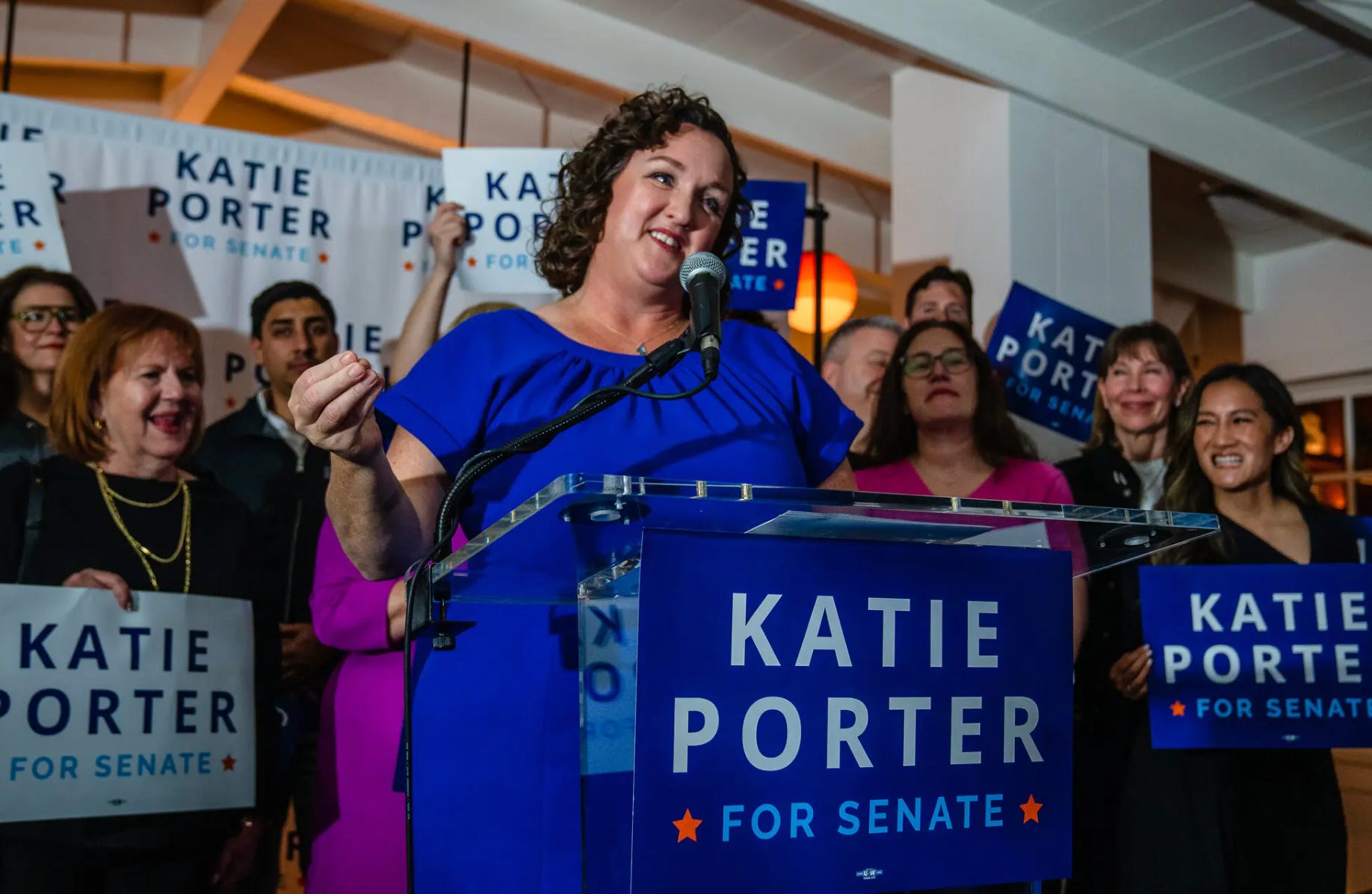
On Sept. 10, Katie Porter was polling as the No. 1 candidate for California governor at 17.4 percent. Now, she has only garnered 4.4 percent of the primary vote and has conceded the race.
The void left by Gavin Newsom in the governor seat invited a bevy of candidates, most underqualified, to fill the role. But early on, Porter emerged as the clear front runner. She won a House seat in a historically red district in Orange County back in 2018, and gained prominence for challenging the Wall Street elite.
What really shot Porter to a solid level of stardom were the props she used during House hearings. In one particular instance, she challenged Wells Fargo CEO Tim Sloan’s assertion that his bank would rebuild trust with consumers by whipping out a whiteboard and showing that his own lawyers contradicted that statement.
Tim Sloan resigned two weeks later. Porter had won that battle. It was exactly what she went to Washington to do. It gave her national recognition and proved, in a way, that a representative from Orange County didn’t have to cozy up to moderates and Republicans. She wanted to challenge the wealthy and affluent, and it didn’t cost her the seat.
But this candidacy didn’t have the same fire or verve that Porter became associated with. Through conversations with political insiders, political science scholars and research, The Truth OC has developed multiple reasons that the Porter campaign ultimately fell from grace.
The money
Flat out, Porter did not have the same war chest afforded to Xavier Becerra and Tom Steyer, the two leading Democrats in the race. Steyer is a self funded billionaire — who was able to put advertisements on seemingly every TV channel and YouTube video in the state via $213 million — and Becerra had corporate donors backing groups supporting him.1
But Porter was never going to be the candidate who took money from special interests. She built her career on standing up to Wall Street bullies. A bigger problem was that she didn’t have the ability to crowd fund well enough to battle in the upper echelon of this race. While she has over 210k followers on Instagram, her posts on there rarely sparked attention in the same way that Steyer or Becerra’s advertisements could. Even if she was a social media star, though, it may not have been enough to compete monetarily.
Data shows that the average winner for a House or Senate seat in 2022 spent essentially double what their opponents did. California currently has a ban on public funding in elections (although this will be put to a vote in November).
This statute gets very messy and confusing, but know that it hurt Porter a lot. Look to New York City. Their publicly funded structure means that grassroots donors, those giving under $250 to a candidate, will have their donation matched by the city. The city also matches donations between $10-$50 at a higher ratio. It is meant to incentivize candidates moving away from taking special interest money, and instead they can focus on the community which will be their constituents.
NYC’s structure is what allowed Zohran Mamdani to win the mayorship. He was able to stick to his morals and focus on his ideas for the betterment of the city, and it resonated with everyday people. He had enough money through this system to win. But in California, that just doesn’t exist currently.
If Porter had access to this system, and also if there was an overall cap on campaign spending, she could have reached voters more directly. Her message could have risen above the money, because she was a good candidate. But as the election went on, and Steyer and Becerra entered the race, it became harder to keep up. That wasn’t the only issue that plagued Porter, however.
The videos
Early October was tough for the Porter campaign. Although she maintained a lead in the polls until January, two videos surfaced that gave Porter an image that was hard to shake the entire campaign.
The first showed Porter having a rough exchange with a CBS News reporter. It painted the image of an abrasive and annoying person. But the second is what killed a lot of trust with the general public.
Politico obtained the video, which showed Porter — when she was a US representative — yelling at a staffer to “get out of her fucking shot”. In any election, leaders have to come off as somebody that you can work with. Talking with a friend a month before the election, he told me that when he saw that video he immediately had no desire to vote for Porter. If you aren’t nice to the people closest to you, then how can constituents trust you to have their best interests in mind?
From then on, Porter was on the defensive. She had to rebuild her reputation, but it is hard to get past damning evidence such as that. Chapman University political science professor John Compton said the idea of Porter’s workplace being toxic was not a new one.
“The videos seemed to reinforce past allegations from staffers that Porter was a volatile boss and that her Hill office was a toxic workplace,” he said. “There was a major Washington Post story on this back in 2023 that featured anonymous allegations from eight former staffers. I don’t think the videos necessarily doomed her campaign, but they seem to have started her downhill slide.”
Not for nothing, dozens of former staffers defended Porter in an open letter saying that she always shows up for her team. This came after Eric Swalwell dropped from the race but it came too late to rebuild enough goodwill for Porter.
These videos created a perception of Porter as, simply put, an asshole. Whether that is fair or not is beside the point, and this image was almost certainly made worse because of Porter’s gender.
Her gender
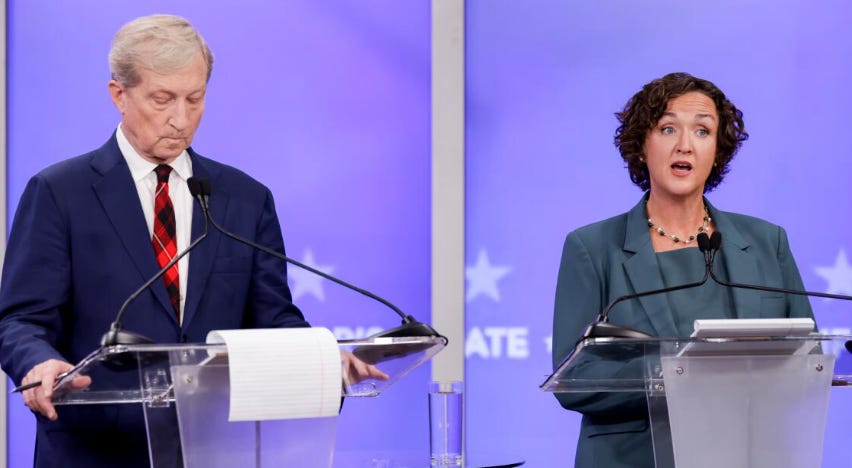
There has never been a female governor of California. Compton believes that comes down to a lack of enough strong female candidates rather than voter sentiment, saying that if Kamala Harris ran for governor she would’ve won. A political insider who only spoke on background said that many people just aren’t willing to vote for a woman.
However you spin it, though, there is a consistent underlying perception that surrounds female candidates. It plagued Hillary Clinton and Kamala Harris in the presidential elections. It plagued women like Amy Klobuchar or even AOC to some extent. They have to be perfect when campaigning. Put on even one slightly sour face in front of the cameras, and it will kill you more than it will kill a man. Yell at a staffer, and your campaign might be over right then.
This has never been more true than it is today, when the president has a history of doing much worse than cursing out somebody on his campaign staff. Donald Trump can grab women by their genitals, or at least allude to it, and he’s fine. He can be heavily linked to Jeffery Epstein, and he’s fine.
There is simply a double standard. When a female candidate makes a mistake it’s amplified. That may not have been the only/main reason that Porter’s campaign failed, but it is worth mentioning. In the public eye, combative women don’t come off as powerful and great leaders. They get seen as irritating and rude.
The candidates
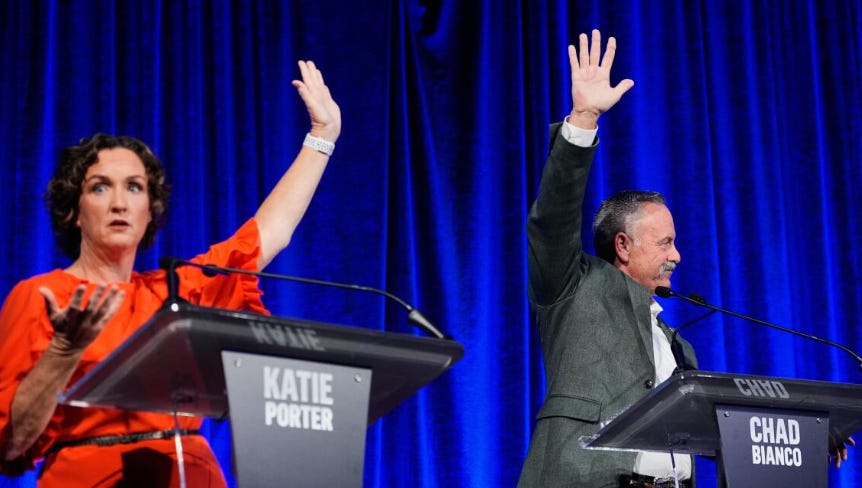
From the jump, there was never a candidate in the Democratic party that wowed voters. Nobody got them juiced and excited. Hell, most voters held their ballots until the final days just to make sure two Republicans didn’t make it to the general election. By that point, Porter simply didn’t have the umph to be voted in. Even if people saw her as the strongest candidate, she wasn’t the most viable. Becerra and Steyer had a much better chance of making it through, and so people bit the bullet.
California’s jungle primary system means that the state’s Democratic Party often eats its best and brightest candidates in favor of more presentable candidates. Those who can have as wide of an appeal as possible. Porter found herself in-between two camps. She has never been a moderate. She is the woman who fought Wall Street with a whiteboard. But she has never been as progressive as somebody like Tom Steyer. Hailing from Orange County — an area far away from being representative of the general California public — she has had to toe the line between moderate and progressive often.
When Swalwell dropped out after sexual assault allegations emerged, Porter should have filled the void immediately. But she never did anything with enough force. Porter didn’t address the ICE raids strongly, didn’t reach out to the communities around her (such as Santa Ana). She didn’t have boots on the ground in a meaningful way. Immigration is the issue of our time in California, and Porter missed a chance to garner support by giving a human touch to people in need.
The fact remains that in a jungle primary system, when you lose viability as a candidate it is very hard to win it back. Compton categorized her failures as representative of voters’ worries rather than her being a terrible candidate.
“On paper, (Becerra’s) resume is more impressive than Porter’s, given that he has served in Congress, served as attorney general, and held a cabinet post in the Biden Administration. I do think Porter was a viable candidate — as you point out, she was leading in the polls at one point. However, I think the weirdness of the jungle primary system, coupled with Eric Swalwell’s flame out, left Democratic voters in a risk-averse mood, which is why a majority of them went for Becerra.”
What’s next for Porter will be interesting. Failed bids at both a Senate seat and at the governorship have placed her on the back foot, but it seems unlikely that she fades away. And maybe if Californian voters allow for public financing of elections, and she can shake off the abrasive image surrounding her, then she can make a strong challenge at any office she desires.
Caleb Otte is a recent Chapman University grad and one helluva writer. One can visit his substack here.
Via CalMatters, “Chevron, McDonald’s, dialysis giant DaVita and one of the state’s largest oil drillers, California Resources Corp., are funding one of the largest pro-Becerra groups, with each of them contributing $500,000. Meta and AirBnB chipped in about $1 million each and health insurance corporation Centene, which runs California-based HealthNet, put in $100,000.”
I appreciate that gender was included here, because I think people still dramatically underestimate how much it shapes political viability. There have been plenty of qualified women who have run for Governor, but men always beat them out.
I'm also not convinced Kamala Harris would have walked into this race and won. The standard for women in politics is still incredibly high: be forceful but not abrasive; be prepared but not condescending; be ambitious but not too ambitious. One small bad moment becomes the whole story.
That's why I think it's the main reason why Katie Porter wasn't nominated. The workplace concerns are fair game, and nobody needs to pretend that a high-stress or difficult office culture is irrelevant. But she was put into a different category because of it. Eric Swalwell had far more serious issues attached to his campaign, and it took a much bigger scandal cycle to make him politically untenable. Porter became "the difficult woman" almost immediately.
And honestly, do we really think Xavier Becerra is some zen, conflict-free person to work for? The difference is that men are much more likely to have intensity interpreted as toughness, seriousness, or executive presence. Women get intensity interpreted as volatility.
So yes, Porter made mistakes. However, I don't think we can talk honestly about her collapse without acknowledging that gender plays a major role in how unforgivable those mistakes became.
Many of us lost respect for her when she left the House to run against a much more experienced anf qualified Adam Schiff. She was awesome in the House and we needed her there. We felt abandoned. Many of us believe Katie is arrogant, all about Katie, not helping Californians