
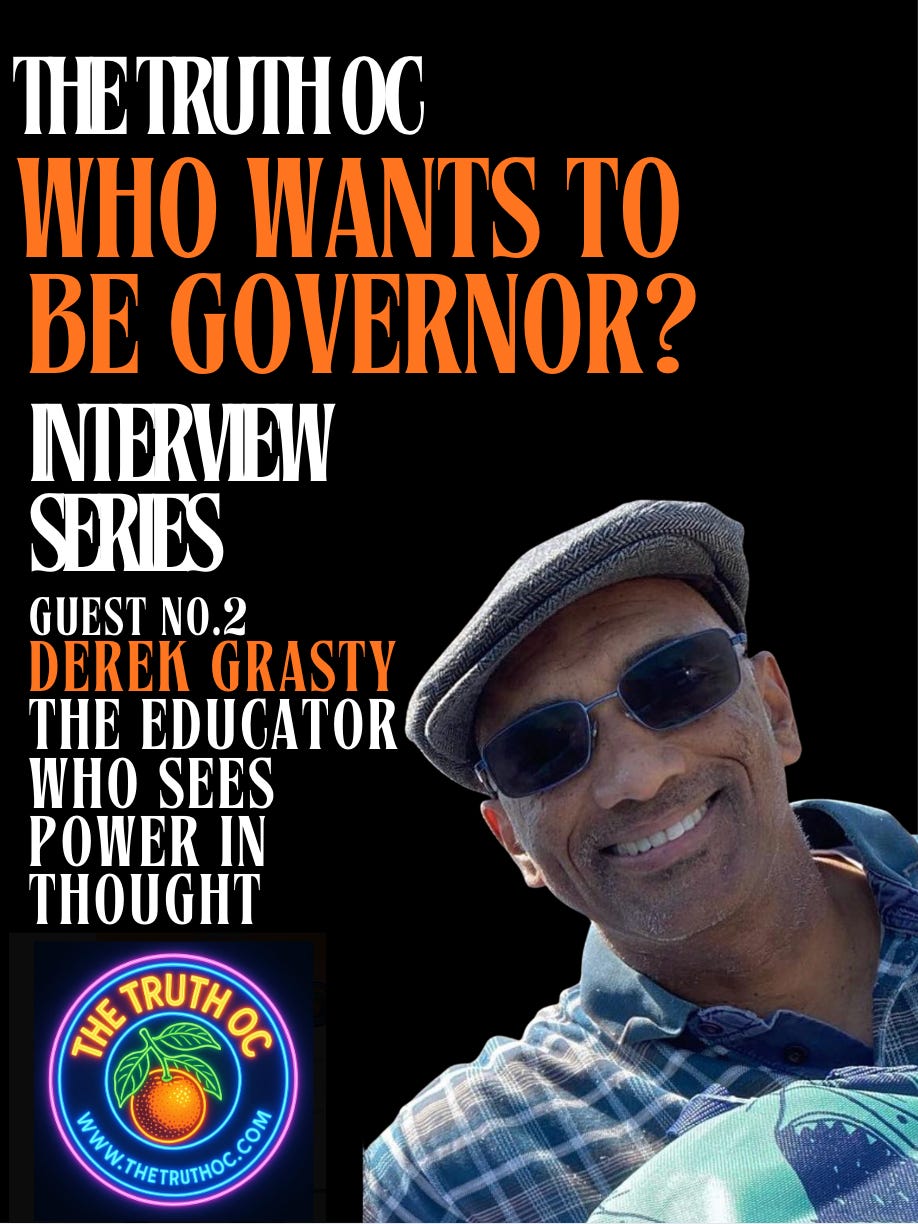
So over the past few weeks I started reaching out to every single candidate for the upcoming California gubernatorial race. I’ve contacted Democrats and Republicans, Green Party members and Independents. And my goal, truly, is to feature every single (willing) participant in a Q&A in this space. I am not here to insult people I disagree with, or hype up people who share my beliefs. I want to hear their views, their takes, their motivations for seeking a powerful-yet-frustrating position.
And then, I want to share it with you, the Truth OC community.
So (drumroll, please) …
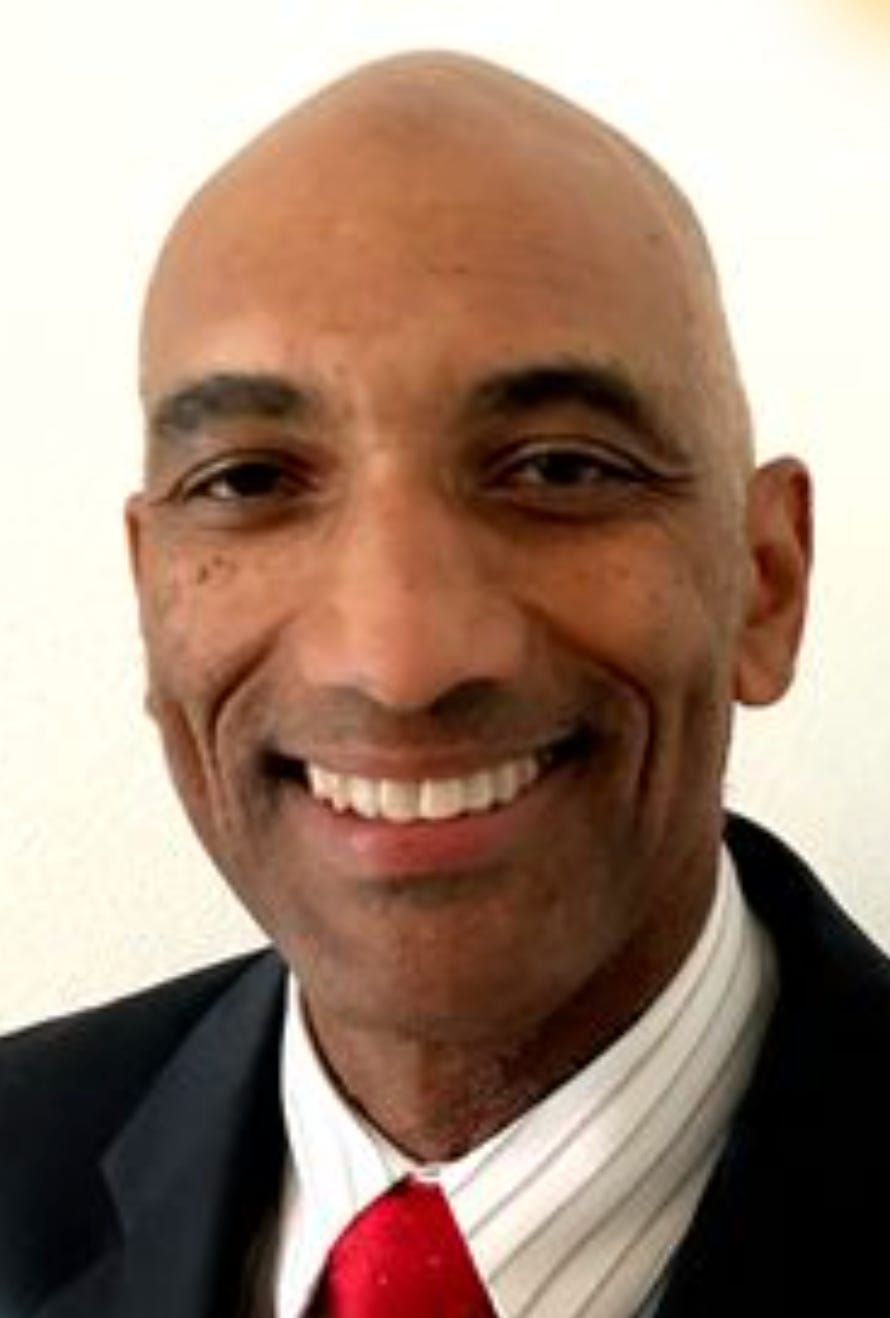
I bring to you Derek Grasty, a candidate for governor and a lifelong educator. Derek is a Detroit native who moved west in 1985 and has spent his life working in schools and on school boards. His political experience is, well, largely nonexistent—a fact he considers a plus in this age of big money and big scandal and an ignoring of ethics, kindness, decency.
You can visit Derek’s website here. Can he win? Well, being honest—it’s a longshot. But is he running for the right reasons? Without question.
JEFF PEARLMAN: “Okay, Derek, first of all, thank you for doing this. I appreciate it. You just told me that you got your wife flowers for Valentine’s Day, so I think you win this election.”
DEREK GRASTY: “Flowers and dinner. Yeah.”
JEFF PEARLMAN: “That’s all you’ve got to do. If you buy that for all the voters and everyone in California, you’ve got this thing wrapped up.
“So lemme ask you first, so I came up with this idea for the website of trying to interview everyone who’s running for governor and there are a lot of people, there are about 30 people running for governor. There are people with a ton of money running for governor, with a ton of name recognition, people with huge backgrounds, people expected to be candidates, preferred candidates, candidates who are going to get the backing of the party, et cetera, et cetera. Your background is in education. You do not have any national political portfolio. Does a person like you enter a race like this with the goal, ‘I’m going to win this thing?’ Or is the goal, ‘Maybe if everything goes right, I can win this thing, but I can bring awareness to issues that are important to me’?”
DEREK GRASTY: “Well, in terms of issues, I’m bringing forward issues that are important to the working people and the common man and common woman. I am in it to win it. I’m not in it just for the fun of it. I feel I have a message that resonates with voters. A year ago this month, Zohran Mamdani in New York was polling at one percent. But he had the right message, the right tone. He resonated with the community and the voters and that’s why he’s mayor of New York.
And I feel I have a similar message that is in tune with the voters and residents of California. I work with them every day as an educator. I’ve touched the lives of many students, many families. I work with many public agencies, whether it be law enforcement, firefighters, nurses, mental health people, and I’ve been all over the state in terms of my scope, my employment, my touch. I’ve been in Los Angeles County, Santa Clara, San Mateo County, Santa Cruz County, Alameda County, even San Bernardino County—where I’ve been at some point either a teacher or principal or mentor coach for administrators. I’ve been all over the place. So I have a background and talking to people on a regular, average, everyday platform, I know what the people are seeing, what they are experiencing and what they need and what they want. And I don’t see any of the other candidates that are in the race, these so-called front runners or billionaires, really addressing the issues that I’m addressing. And so that’s what separates me from the crowd.”
JEFF PEARLMAN: “You’ve been in academia for a long time. I think people would say, ‘Well, what does that have to do with governing? What is the correlation between working in education and then running a billion dollar state budget and handling a fire emergency here and maybe an employment lockout there?’ What is the correlation between your experience and actually serving as the governor of a state?”
DEREK GRASTY: “Okay, well first of all, as a principal, you’re working with people, you’re working with the community, you’re out there addressing people face-to-face. You’re not just somebody in an office. And I’ve worked in working-class communities such as Hayward and currently Mount Pleasant. I’ve worked in very low income areas including Mount Pleasant, East Palo Alto, Linwood in Southern California. And I worked in very affluent communities. I was principal in Palo Alto. So I’ve seen the gamut of people and working with the community and I feel that gives me an edge over most people. There are days where I’ve had literally breakfast with millionaires, lunch with working people, teachers and other community leaders and dinner with people on public assistance and people who are homeless. So I’ve had the gamut of the community and so that separates me from the other crowd. Also, as a school board member, I’m setting policy, I’m setting policy that impacts not only students, but staff. I’ve worked with unions. My background as a teacher … I’ve been a teacher, negotiator, contract person, elected treasurer, and I’ve been on both sides of the aisle in terms of labor and administration and management.
“Also, you mentioned the money. I’ve been on bond oversight committees. I served in the East Side Union High School district bond oversight committee from 2011 to 2017, and we’ve had parcel tax, we’ve had bond measures passed. I’ve been part of a group to oversee over a half billion dollars worth of taxpayer dollars, making sure that projects are completed on time, on budget, and we’ve made that happen. So I feel there’s certainly a direct correlation between what I’ve been doing, my background and experience, and what is called upon me to run the governorship. And mainly it’s accountability, because schools don’t have very much money, and so we have to be accountable for every quarter. And as a board trustee, I know how to squeeze a quarter and get two dimes to nickel and a penny. So from that aspect, I’m very fiscally responsible.”
JEFF PEARLMAN: “I’m fascinated by a few things. So with your career in education, I feel like the greatest change, certainly from when you and I were in school to now, are cell phones and the role of social media, the role of iPhones, the diverting of students’ attention spans. Are there things you see as a state that can be done to better the public school education experience of students as a whole body?”
DEREK GRASTY: “Yes. Well, we first have to make sure that what we’re teaching children is addressing their needs, something relatable to them, their culture, their life experiences, and make it interesting for them. As an educator, I can tell you that we need more civics in schools, because it gets more people to vote and understand how voting … as Obama said, elections have consequences. That your ability to get out and vote and let your voice be heard is very important to your future and your kids’ futures. So that needs to be done. Ethnic studies, we need to, there’s so much discontent, people not knowing who’s who and their background and experiences. We have a government in Washington right now. We want to ban books and making sure that history is suppressed. We need Jewish history, Black history, indigenous people’s history, Latino history, Italian history. We need everybody’s history because it’s all important. We’ve all made contributions to this country.
“And so that aspect needs to be taught. And the Black experience didn’t start at slavery. We were in Africa building pyramids long ago. So we need to make sure that people understand their history, their culture, and their experiences, and there are some shared dynamics across the board. And I think that can help bring people together as opposed to pull people apart.
Also, financial literacy, we need that in schools. Kids, as you mentioned with the technology, they don’t really understand. A lot of them see money. They see a credit card and they think it’s, oh, like it’s a slot machine or something. There are real dollars behind a credit card and we need to do more in terms of teaching financial literacy. California’s 50th in the nation in literacy. We need to improve in that area. One way is we need to have more reading specialists in the schools and we need to have preschool where we are also working on reading. And we need to make sure that our teachers get what they need in the classroom to deliver quality instruction to our kids.
“And we need to make it affordable, not just for teachers, but for all first responders. I’m talking about nurses, firefighters, paramedics—they’re all part of our community and they can’t live 200 miles away and be expected to drive in a real emergency. So we need to make housing affordable for them. And there are simple things that we can do to make that happen. One thing is there are people … and you probably know about this; coming in from foreign countries, all cash, buying houses above market rate, raising our property taxes, and they’re not even living in the homes. They don’t want to be landlords, so nobody’s in the home. So they’re sitting vacant above market rate. So two things are happening. One, our housing is becoming more expensive, setting us up for a crash somewhere down the line. And also they’re contributing to the housing shortage because no one’s in the house. And I propose legislation that if you do not live or work in California, you don’t need a house. So let’s make sure that housing is for Californians.”
JEFF PEARLMAN: “How would one implement such a thing? How do you prevent someone who lives in Nevada and wants to buy a rental property in the state of California from buying the property?”
DEREK GRASTY: “Well, first of all, there are some simple ways. Where does your driver’s license say you live? Where did you pay your last taxes? Where do you work? I mean, all those things can be answered and give an answer as to where someone really lives. And so, using a variety of means and metrics, we can find out who lives where.”
JEFF PEARLMAN: “I read in a piece that was written about you recently, you listed your top three priorities, and one of them was pushing back immigration enforcement. Have you been disappointed in Governor Newsom’s efforts to fight back against ICE, or do you feel like there’s more that can be done?”
DEREK GRASTY: “Oh, yeah. I believe there’s a lot more that can be done. I mean, they got a start of saying, ‘Well, you’ve got to be unmasked and you’ve got to have ID, but there’s no teeth behind it. Well, what if they don’t have an ID? What if they do wear a mask then? So it is legislation that sounds good on the surface, but doesn’t really change the dynamic of what people are experiencing in the streets. For example, in my school district, we’ve had ICE come by a couple of times, one particular time at an afterschool program, and parents were afraid to pick up their kids, so staff had to drive the students home. So that’s real experience that I have in my community.
“What I propose is an amendment to penal code 207, which states that if you are wearing a mask or not, you have no badge or ID, you’ve got an unmarked vehicle, no warrant signed by a judge, and you’re trying to move people from place to place … you are a kidnapper and should be treated as such. And law enforcement should have the lawful legal right to protect residents and citizens against kidnappers. And everyone should have the legal, lawful and human right to safely evade kidnappers by any means necessary.”
JEFF PEARLMAN: “Would you be concerned at all? I’m not saying I disagree with you, it sounds good in concept, but the idea of Los Angeles police, just as an example, arresting federal law enforcement … you would have local police officers arresting federal officers. Does that almost give a little bit of civil war vibes …”
DEREK GRASTY: “Yeah. Well, in terms of, well, if they have the proper paperwork, if they’re going after criminals, they have a signed warrant, signed by a judge, then there’s no problem. But as we’ve seen, only 13 percent of the people that are actually being arrested are criminals. They’re going after regular people. I was watching the news today and a Russian woman in San Francisco was picked up by ICE and she’s here lawfully and so forth and trying to get her paperwork and everything, and they arrested her and for 12 hours she was missing. So we need to protect citizens. People should not have to live in fear. I mean, this is Gestapo-like tactics. And we need to push back against that. Law enforcement does not have to be physically violent and confront federal agents, but if they have a duty to safely protect citizens and these ICE people, who have no warrants, just are impeding their ability to do their job, then yes, they’re breaking the law. They’re breaking California state law and they should be dealt with accordingly.
“I mean, many of these ice agents wear police on there. There’s no federal police. There’s C-I-A-F-B-I, US Marshals. There’s no federal police, so they’re impersonating police officers. So that in and of itself is a crime. So we need to make sure that if you’re going to be who you say you are, then be who you say you are. And you have to obey the law too. They can’t break the law. And our second amendment gives us the right to protect our citizens against the corrupt government. People. Forget about that part of the Second Amendment and what we’re seeing right now. We are legally and lawfully within our bounds by the Constitution to protect our residents and citizens against a tyrannical government.”
JEFF PEARLMAN: “So here in Orange County, I’ve dealt with a lot of people who are involved in school districts, et cetera, and usually someone says, ‘Okay, I’m involved in the Capo Unified School District. I really enjoy this. I’ve been on the board. I’m going to run for water board, and then after doing water board, I’m going to run here and then I’m going to run here, and then I’m going to run here.’ So you’re a longtime educator, you’ve been involved with education for a long time. I’m kind of fascinated. How do you actually decide to run for governor? What was the actual thought process?”
DEREK GRASTY: “Yeah, well, I’m glad you brought that up. Several things. I’m an action-orientated person, and to get things done, you have to be in a position to do things. And I believe from the governor’s office, I can get more done than, say, city council. I mean, in San Jose, for example, there are 10 city council people including the mayor. Well, if you’re in the minority, how effective can you be when you’re always voting in the minority?
“I mean, you can do little things for your own district, but I’m looking at the big picture. How can I make systemic change for everybody? And that’s where I am, all about systemic change. I was a vice principal for many years and I vowed I would not work as a full-time vice principal again, because in many cases I felt I knew more than the principal. But also you’re supporting someone else’s agenda. You’re supporting someone else’s vision. And I believe my vision, my agenda from talking with people, average everyday people, working people, middle class people … we’re being ignored. Our voices are not being heard. And I can make systemic change from the governor’s office more so than I can from a local office because what happens locally, the same issues are going on all across the state. So you might as well tackle the whole problem rather than trying to deal with just a piece of it, I think there is a perception of people saying that there’s a stepping stone of things going on. I mean, using a terrible example, Trump—was he ever dog catcher? Was he ever city council person or even Tom Steyer? But they have money. So people say, oh, it’s okay. They get a pass. Why does money get a pass in a democracy? It should be about ideas, it should be about vision, it should be about leadership. It should be about, can you connect with the people?”
JEFF PEARLMAN: “Wait, I asked you this question. I’m being serious. How does a guy with, at this point, a relatively low profile, go from here to the governor? What are the steps you think you have to take to become a viable candidate?”
DEREK GRASTY: “Yes. Well, I think you hit it—it’s visibility. And the more things I do like your interview, the more things that are put on the Internet … which I feel is a great equalizer in terms of getting the word out. Things can go viral overnight. I think those types of things. So they level the playing field for somebody like myself.”
[Watch the above video for the interview in its entirety]